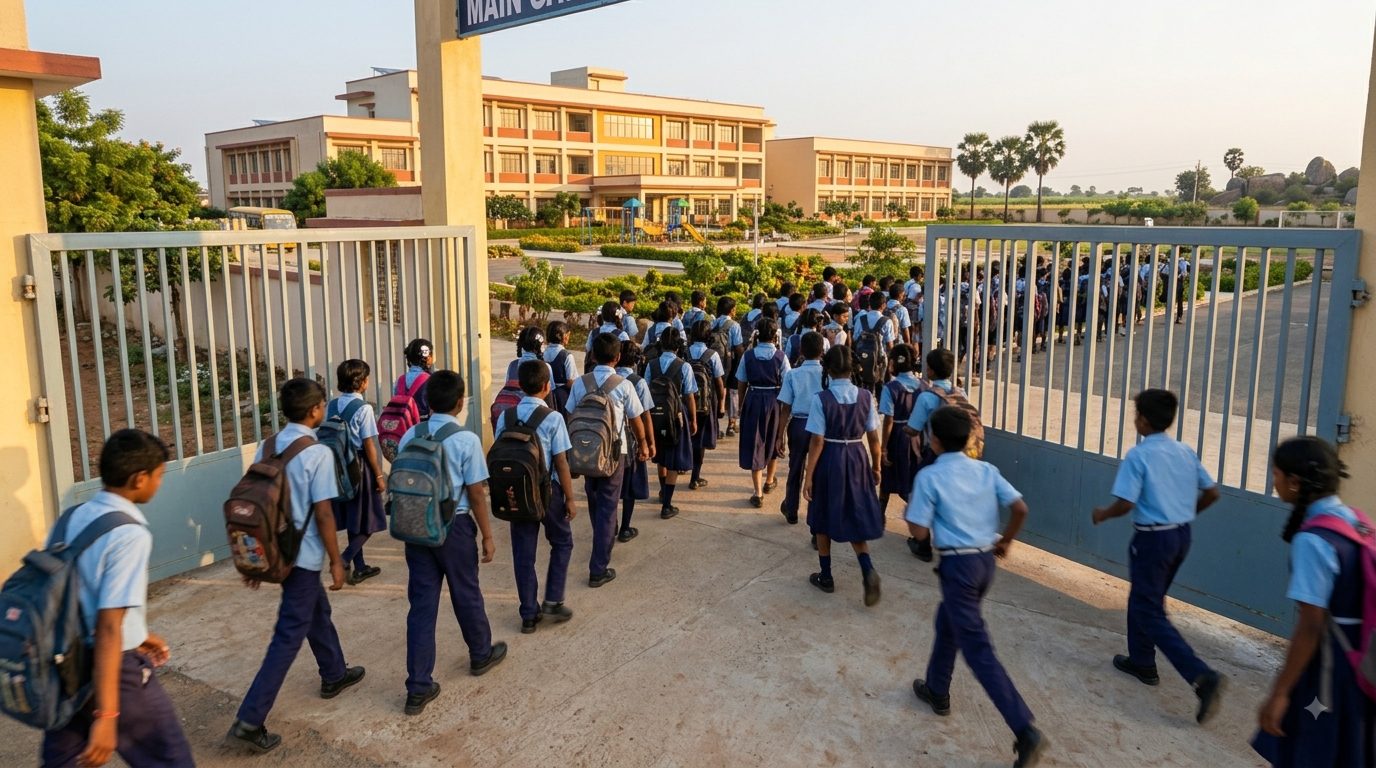
The difference isn’t money the country doesn’t have. It’s a plan the country hasn’t demanded. Here’s the plan.
The big idea
Stop patching failing schools. Build one that’s world-class — and bus every child to it.
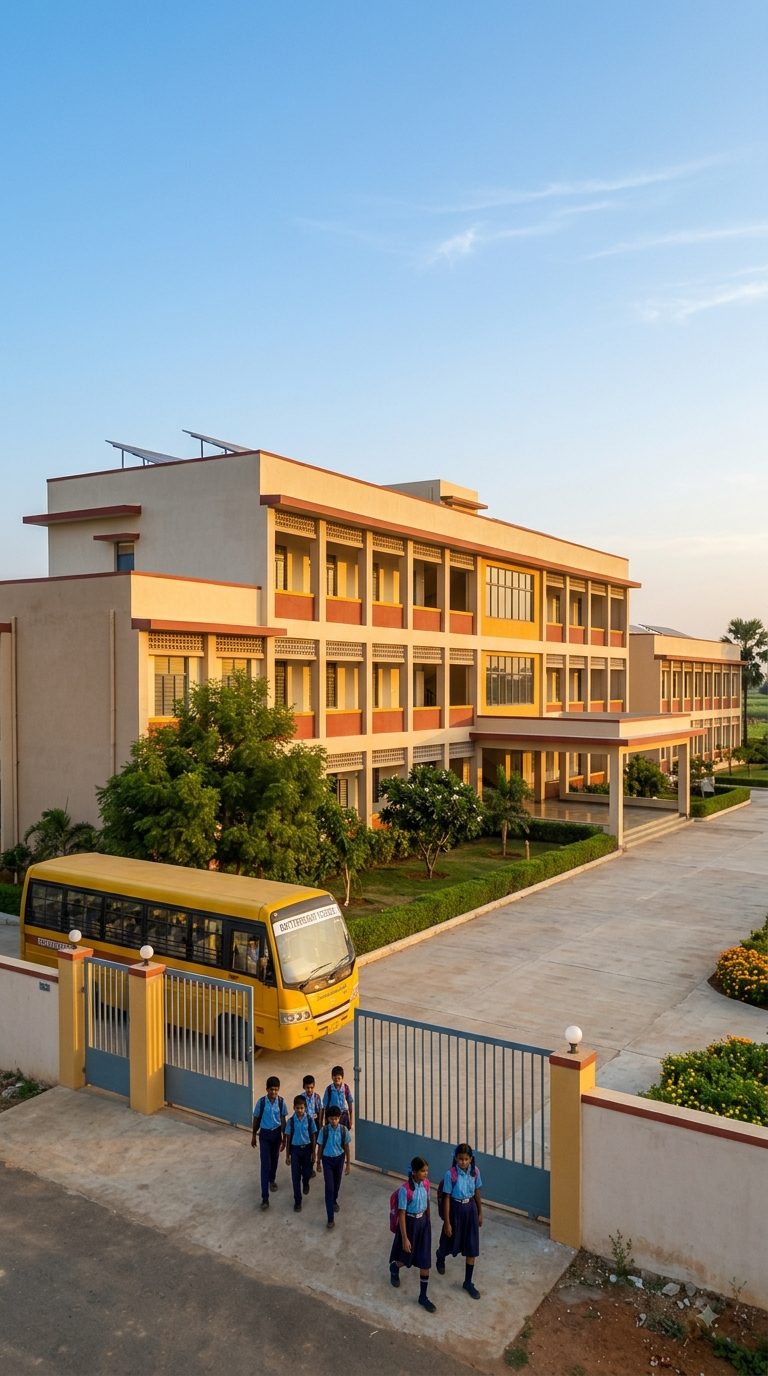
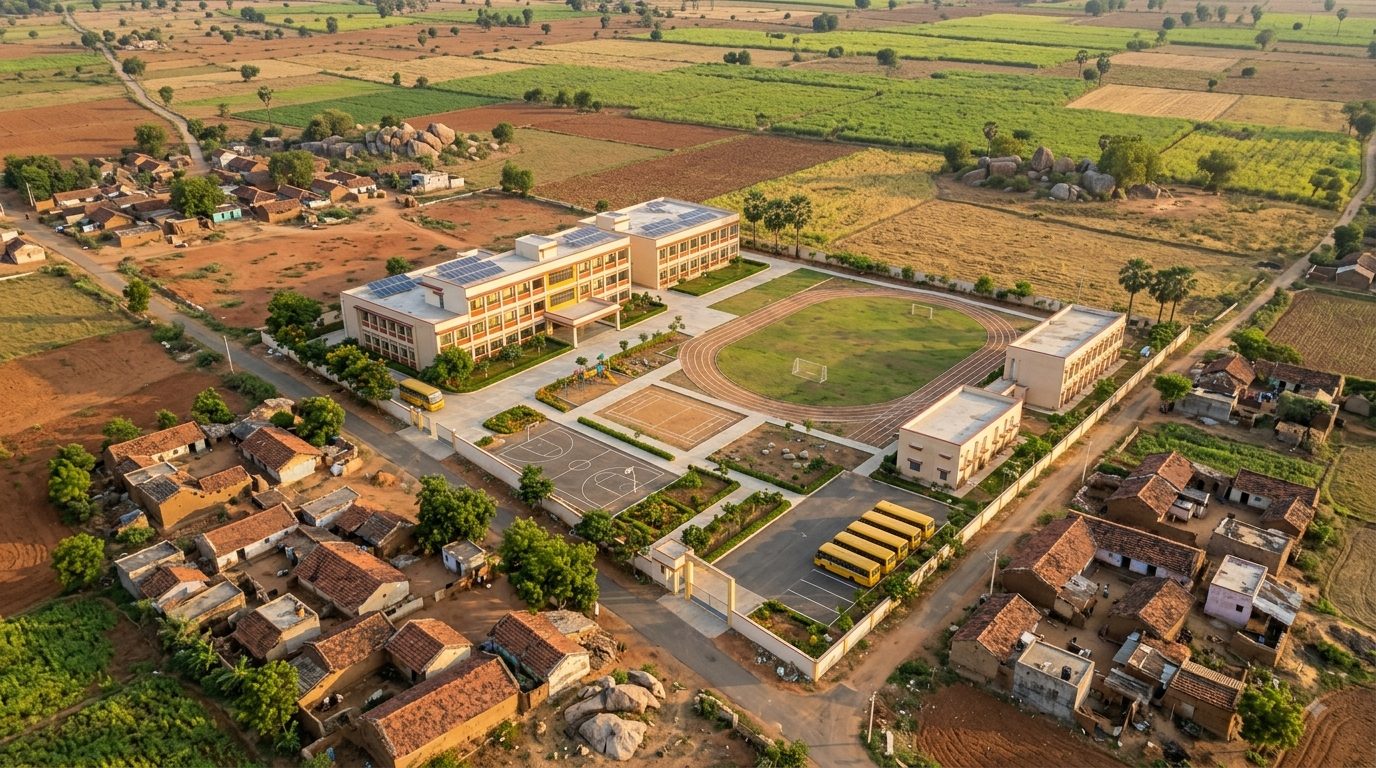
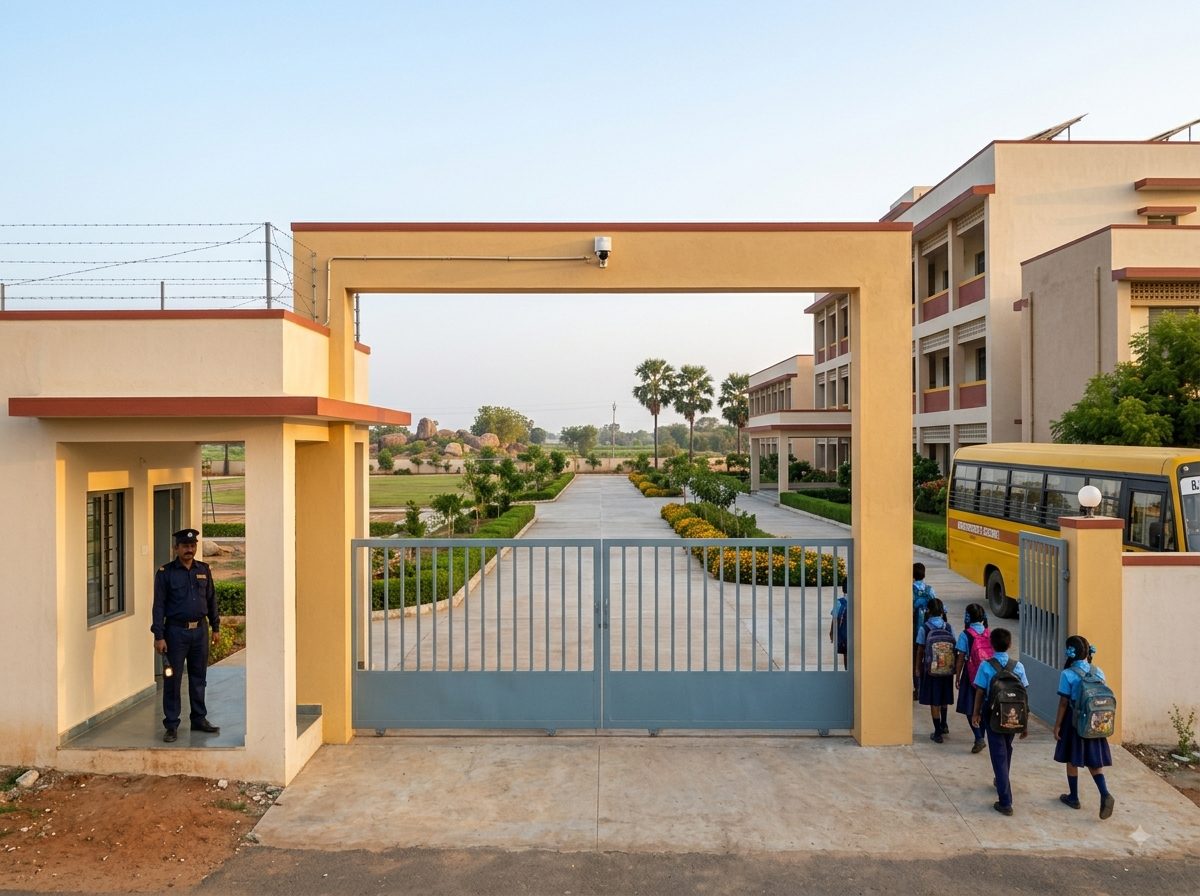
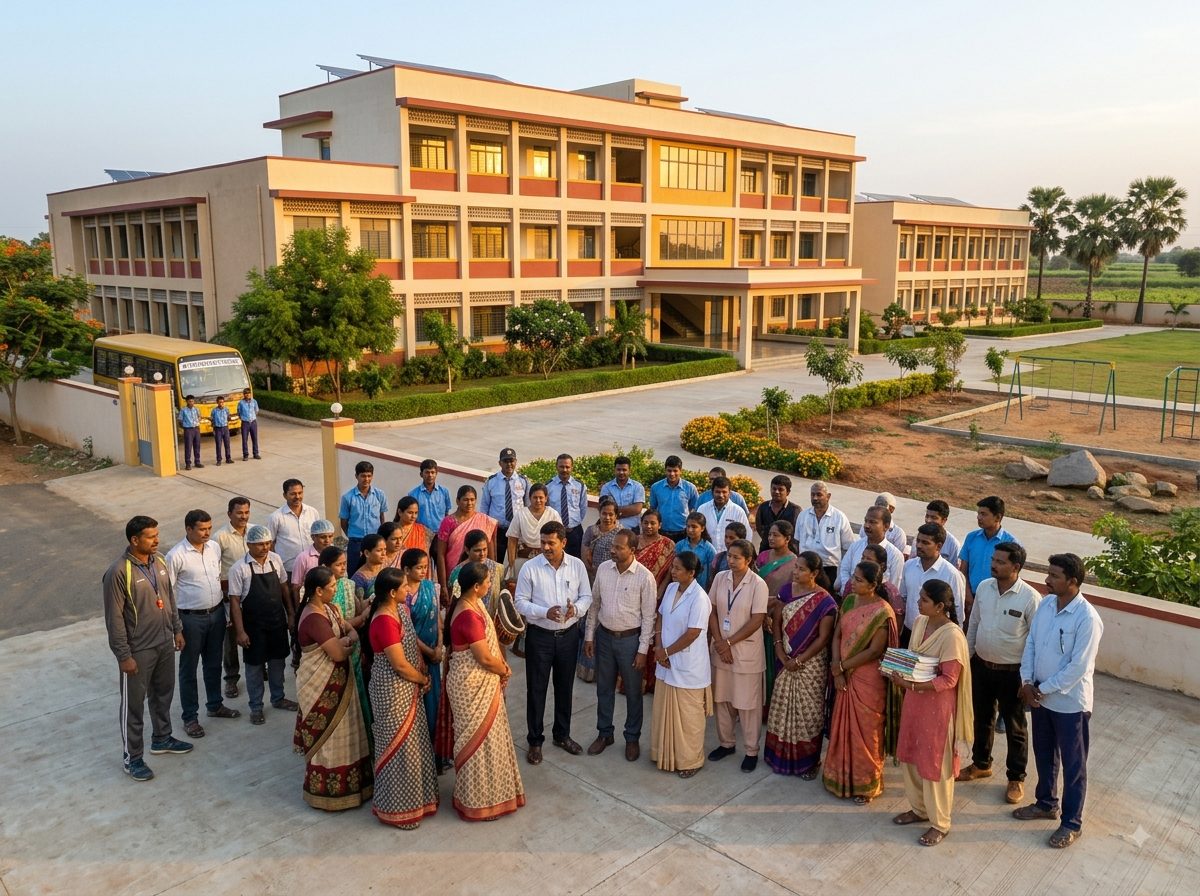
A mandal is split into 2 to 4 clusters, and each cluster gets one big campus — around 1,500 students, pre-primary to Class 12, with no school fees. Every village in that cluster is on a bus route.
2–5 campuses per mandal
~1,500 students each
Pre-primary → Class 12
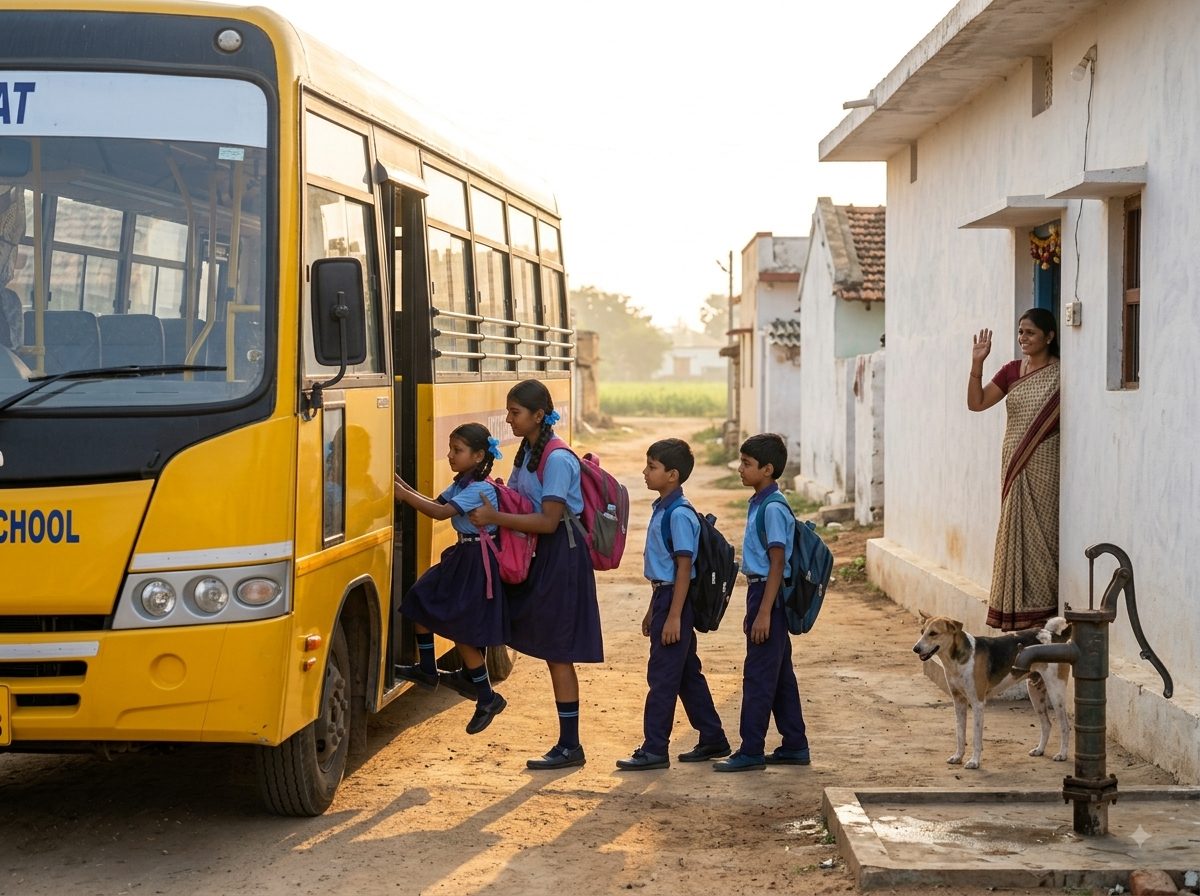
5 school buses
The campus is not built from scratch: in every cluster one suitable government school is upgraded with world-class infra & facilities — and buses bring the rest of the cluster’s children in.
Artist's impression
The blueprint, not a wish list
The report defines exactly what a real school needs — 45 things. Ours will have all 45.
Tap a zone to see exactly what is in it. All of it standard — not “premium add-ons.”
45/ 45
45/ 45
45 out of 45. That’s the standard. Why should a poor child get anything less?
Zone 1 of 8
🏫Academic Core
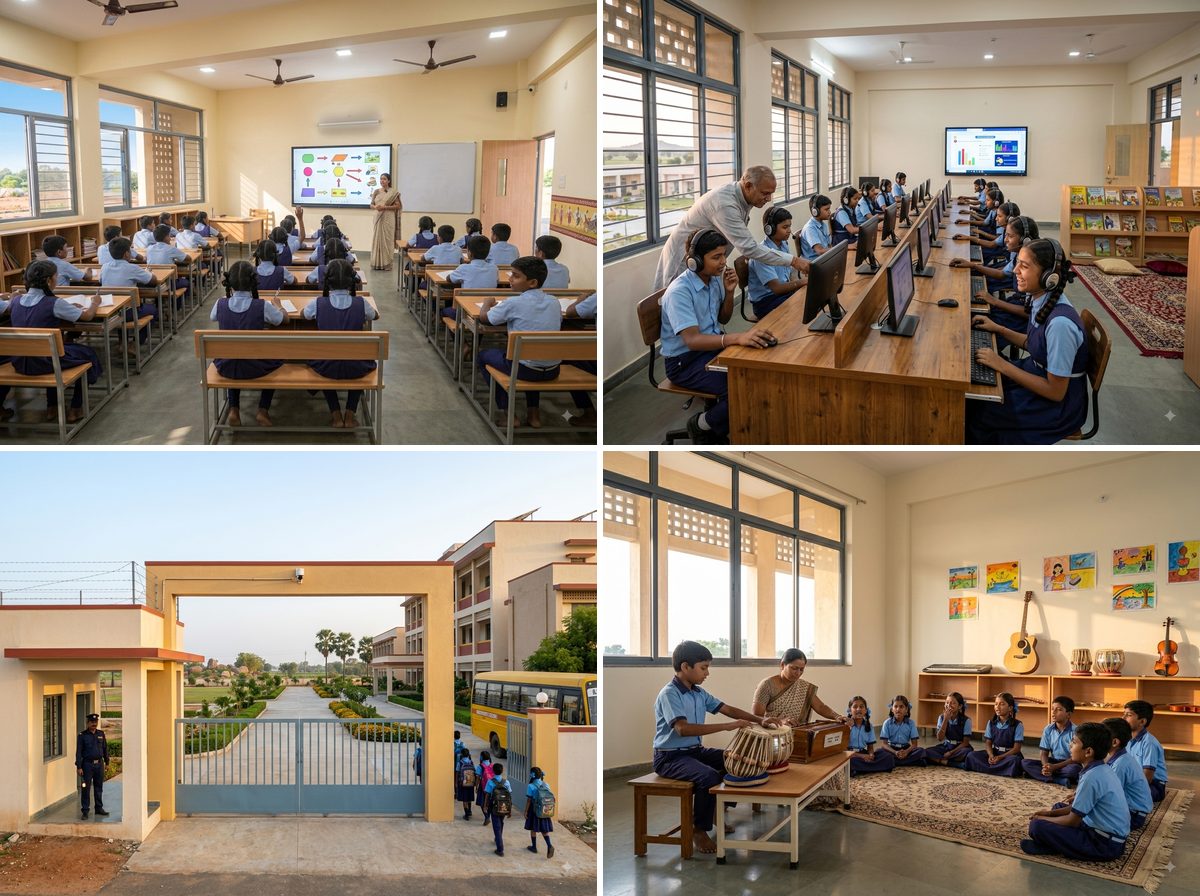
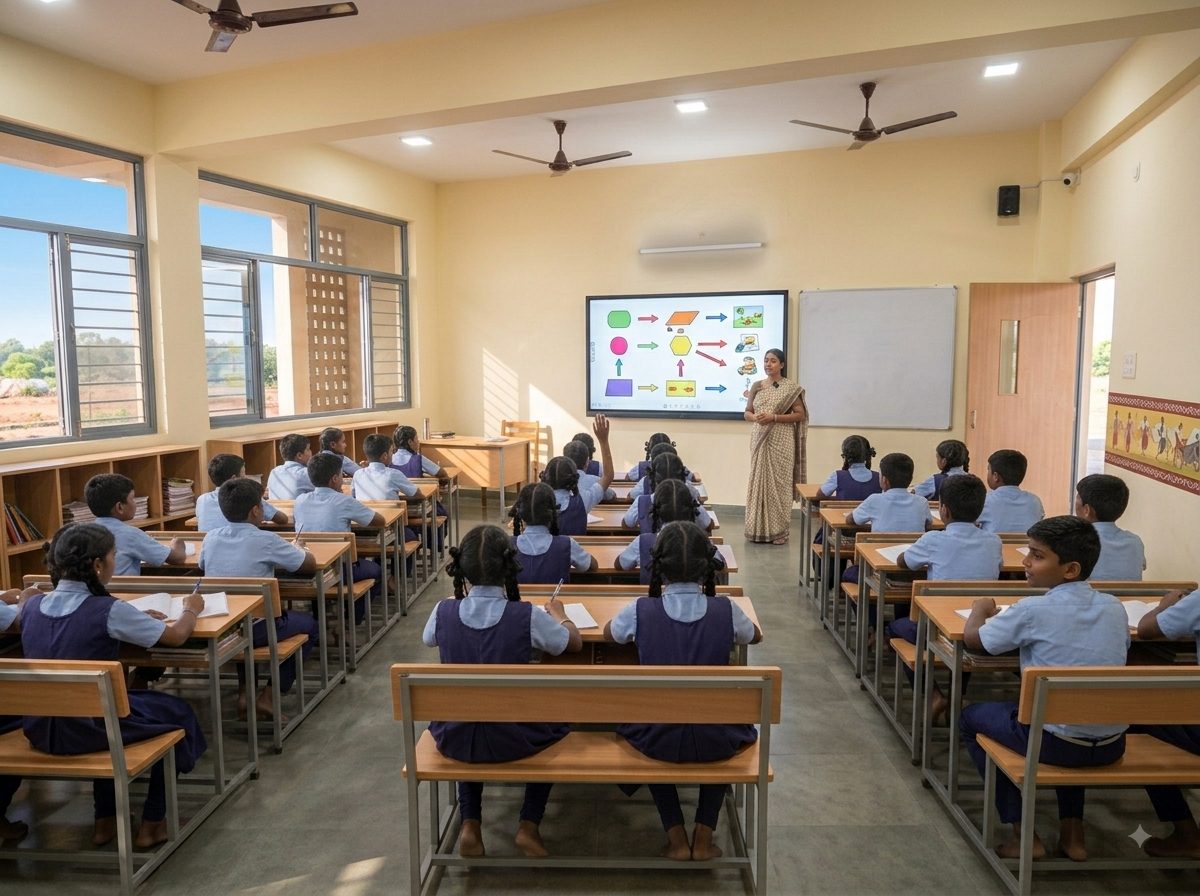
Right-sized classrooms where every child can see, hear and be heard.
2One classroom for one grade — not more than 20 children per class in pre-school, 30 in primary, 40 in high school
3One activity room (40′ × 30′) for pre-primary students
5The required number of lights, fans and big windows in every classroom and room, for abundant light and ventilation
12A public-address sound system across the school, connecting to all classrooms
14Mobile wireless microphones for all teachers, to use while teaching
17Dual desks for Classes 3–10, and tables and chairs for Nursery–Class 3 and Classes 11–12
18Tables and chairs for teachers
19Whiteboards in all classrooms and laboratories
20Interactive Flat Panels — 85-inch screens — in all classrooms and laboratories for digital learning
25Internet available across the entire campus
✓ 10 of the 45 standards — included as standard, not a premium add-on. Numbers are the report’s own.
Zone 2 of 8
🔬Labs & Innovation
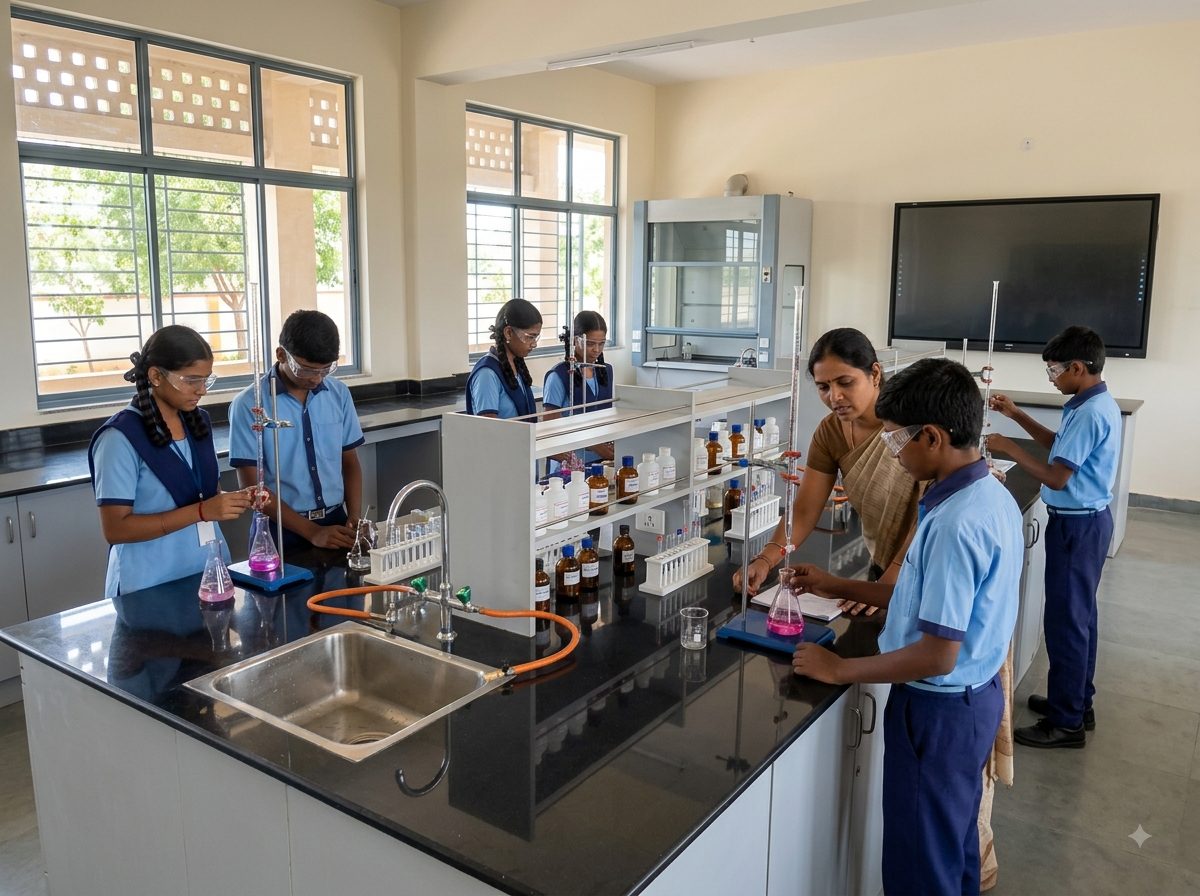
Where curiosity meets equipment — including an AI lab and four separate science labs.
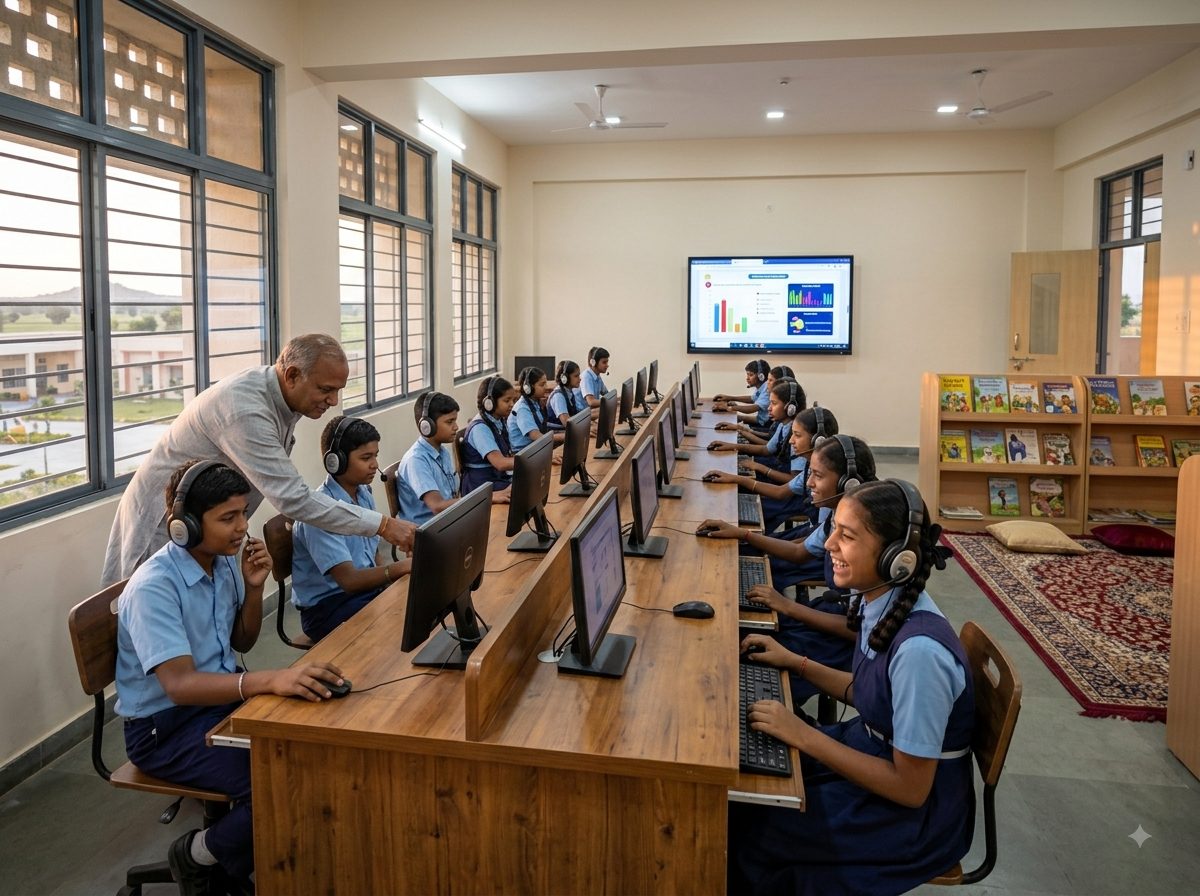
21Computer-cum-AI laboratories with the required equipment and furniture
22An English Lab with digital content and an 85-inch screen
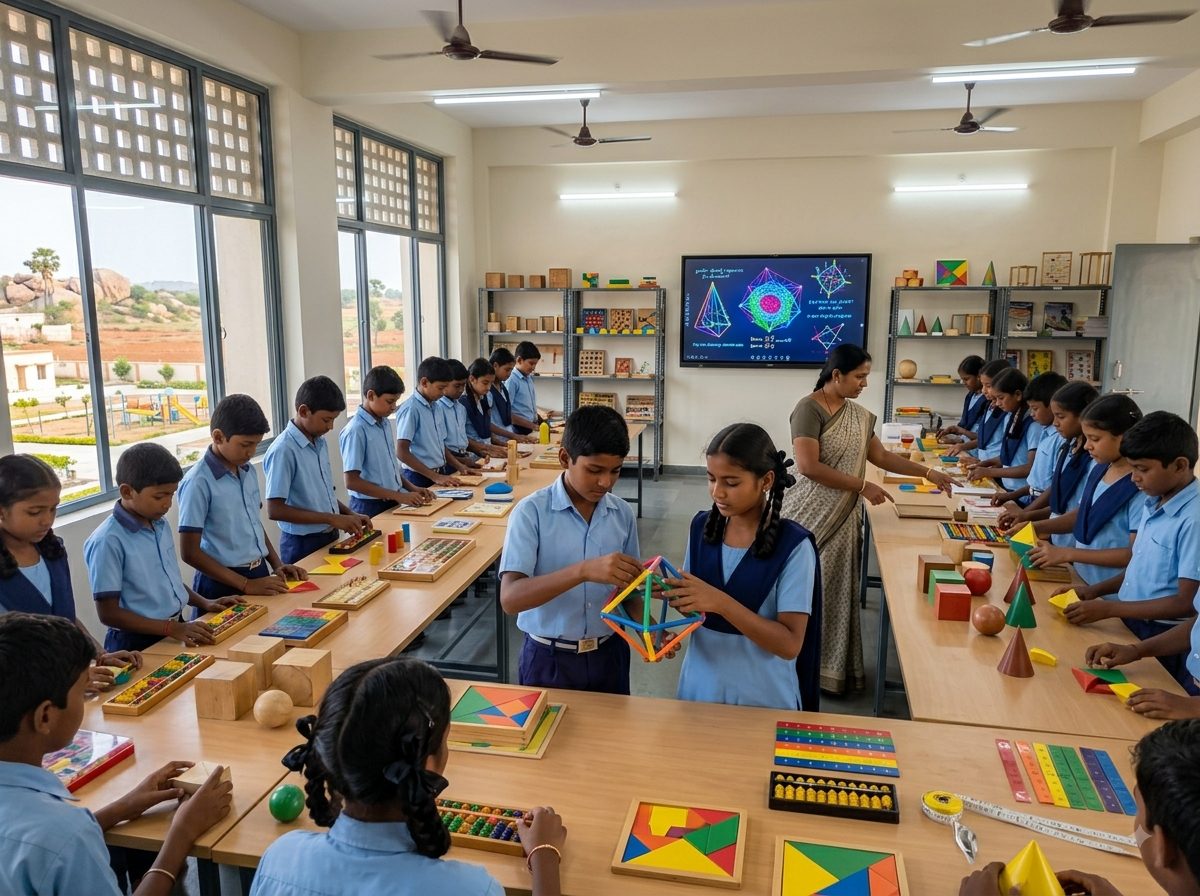
23A Maths Lab with an Interactive Flat Panel
24Four science laboratories — Physics, Chemistry, Botany and Zoology — with full equipment and infrastructure
26Vocational training labs and skill labs, to promote entrepreneurship and skilling
✓ 5 of the 45 standards — included as standard, not a premium add-on. Numbers are the report’s own.
Zone 3 of 8
📚Libraries
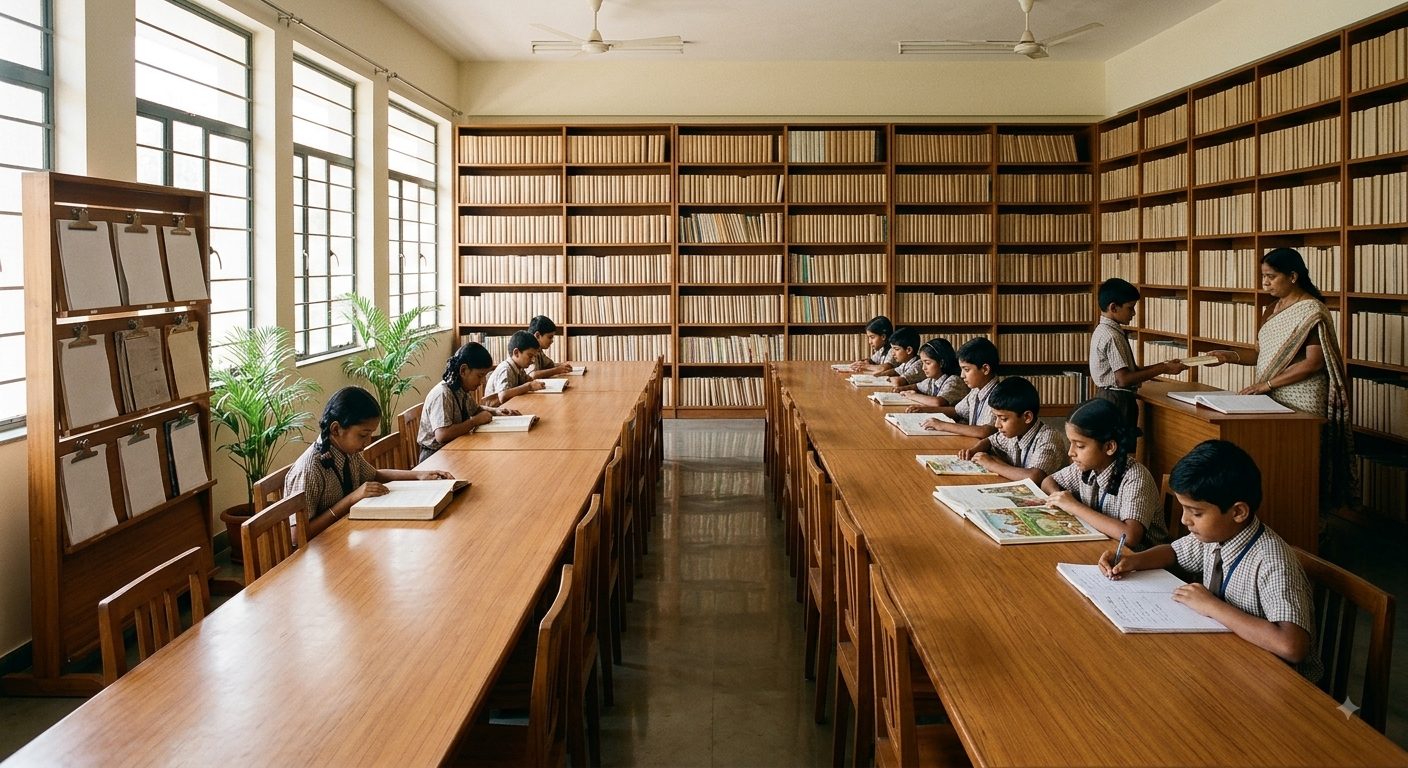
Two real libraries, so no child has to wait their turn to read.
4Well-equipped libraries with books, newspapers, magazines and furniture — one for Classes 1–8, another for Classes 9–12
✓ 1 of the 45 standard — included as standard, not a premium add-on. Numbers are the report’s own.
Zone 4 of 8
⚽Sports & Play
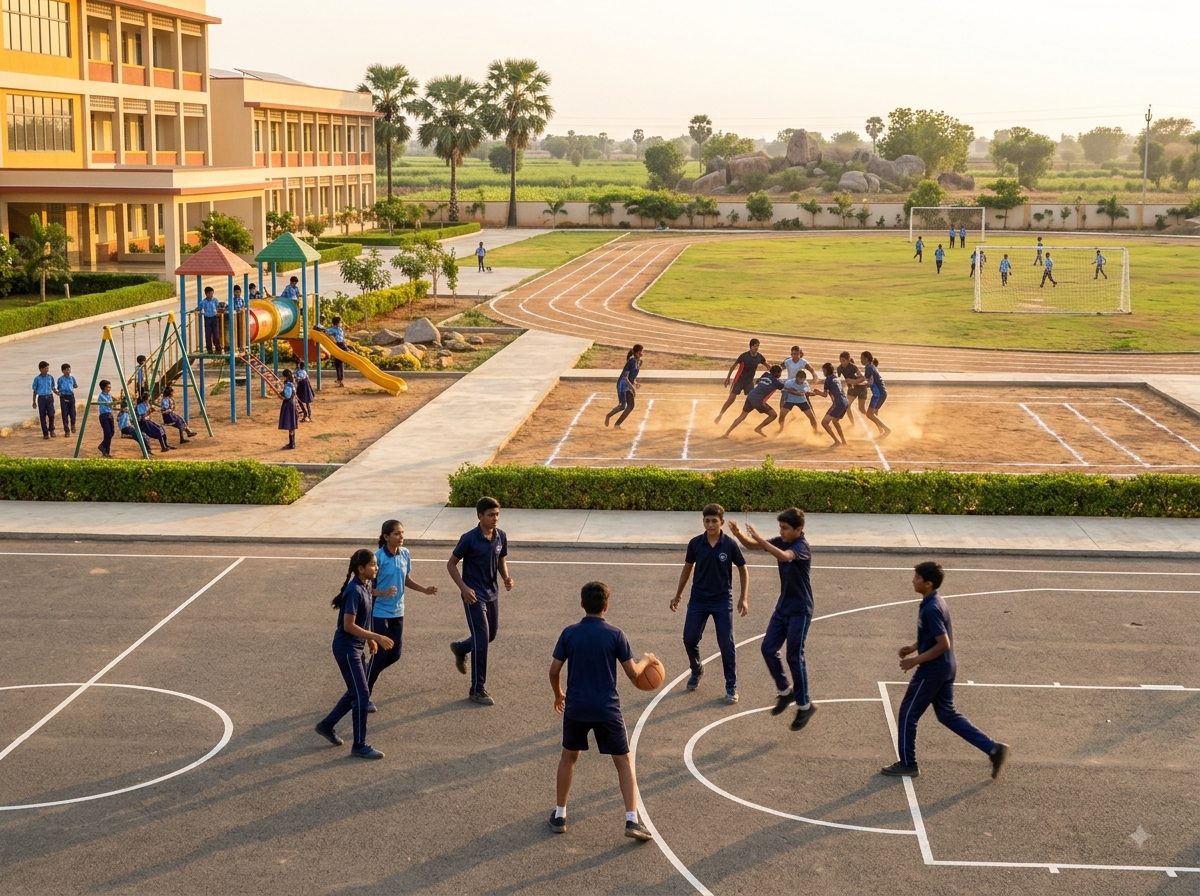
Eight sports outdoors, and somewhere to play indoors when the sun is fierce.
32Outdoor play courts for high-school students — basketball, volleyball, cricket, badminton, football, kabaddi, kho-kho, athletics
33An outdoor play area and equipment for pre-primary and primary students — swings, slides, fun stations, adventure sets
34An indoor games and sports area for all grade levels — table tennis, carroms, chess
35An indoor play area with equipment for primary students — trampoline, play toys, soft toys
✓ 4 of the 45 standards — included as standard, not a premium add-on. Numbers are the report’s own.
Zone 5 of 8
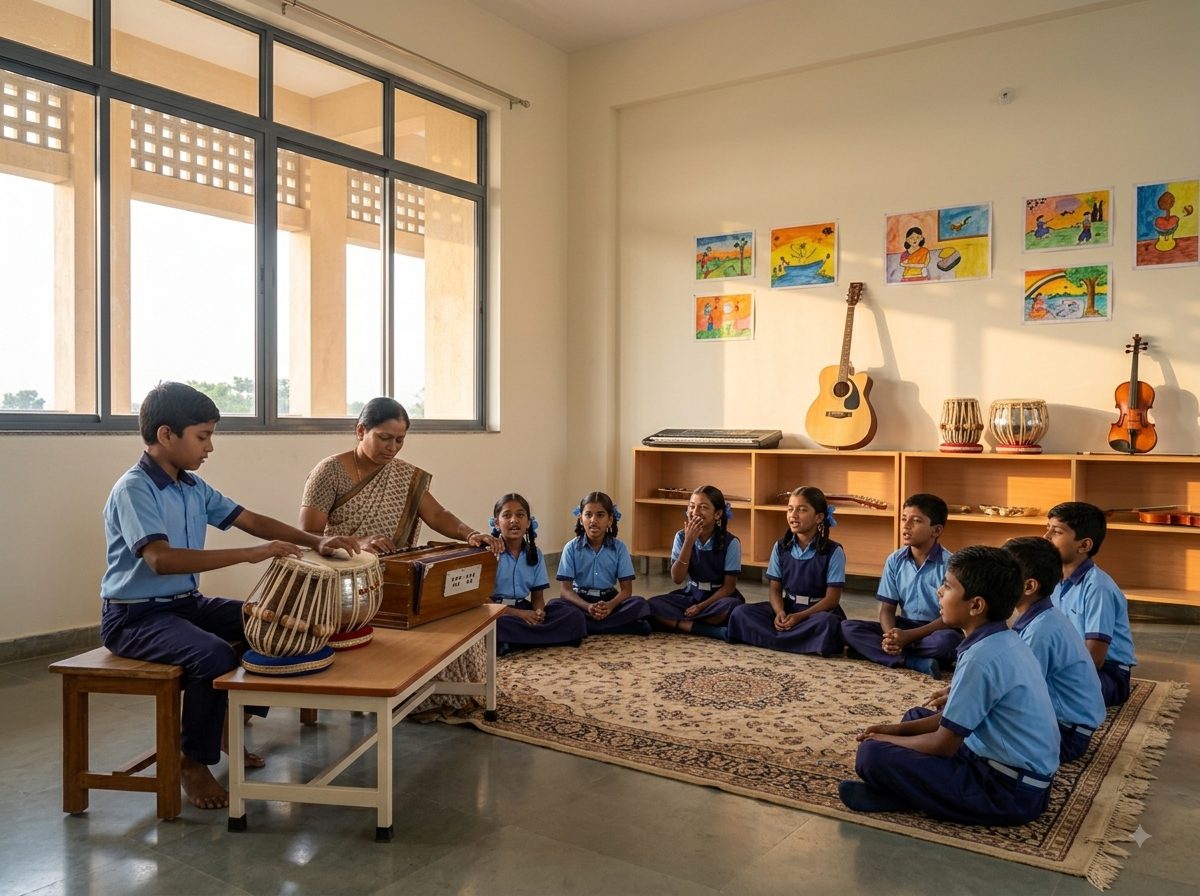
🎨Arts, Culture & Values
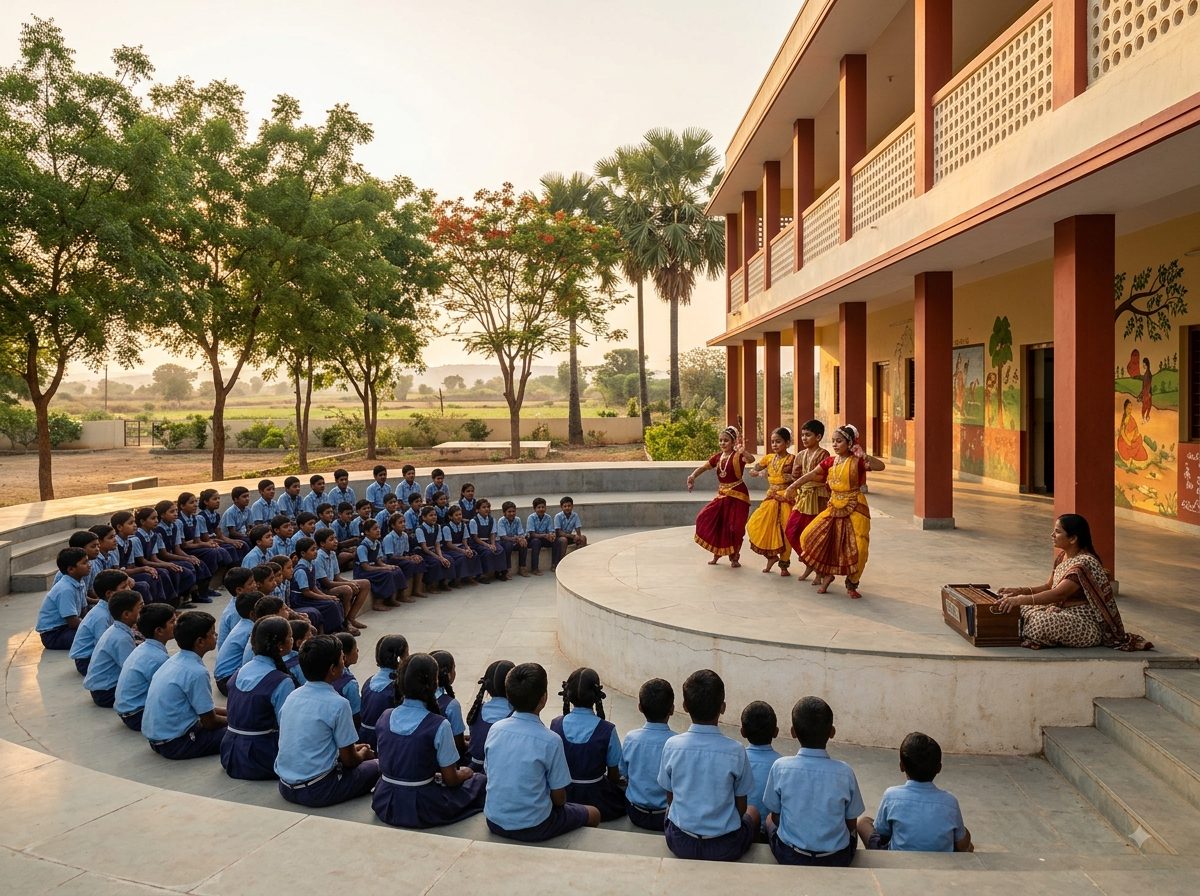
Music, colour and the Constitution — the parts of school children remember forever.
13One games room, one arts-and-crafts room and one music room
30Decorative wall art in classrooms and verandahs
40Attractive paintings across the entire school campus
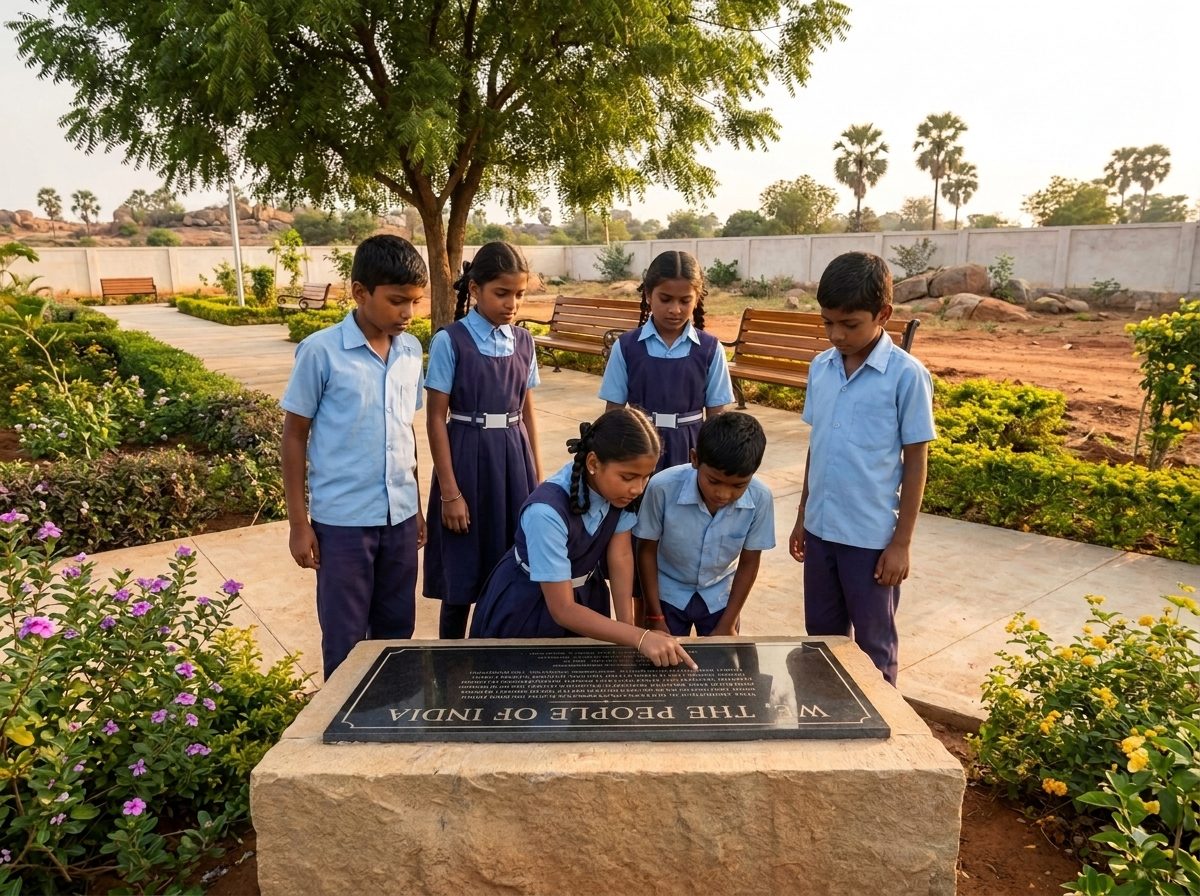
42A Constitution Park — a dedicated open space with the Preamble of the Constitution on a plaque
43An outdoor open-classroom area cum amphitheatre
44Landscaping across the entire school premises
✓ 6 of the 45 standards — included as standard, not a premium add-on. Numbers are the report’s own.
Zone 6 of 8
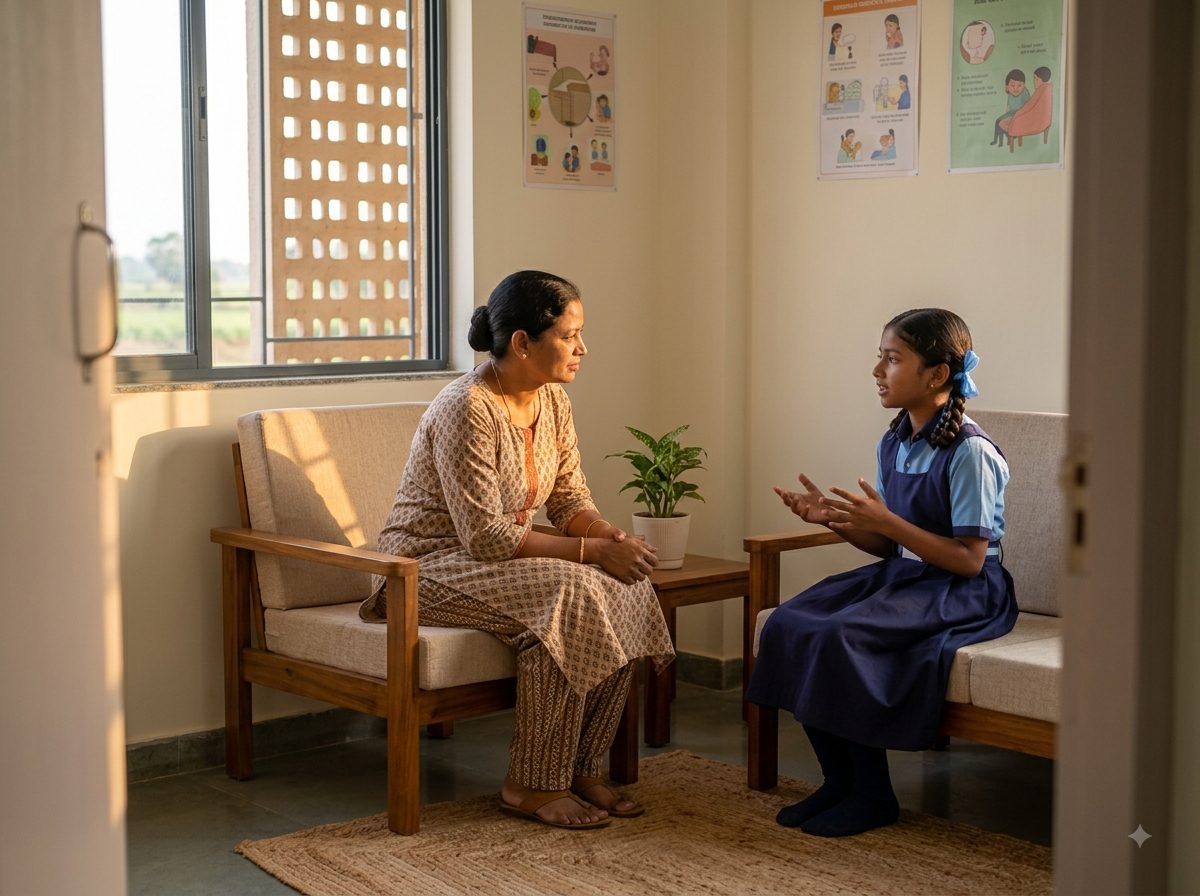
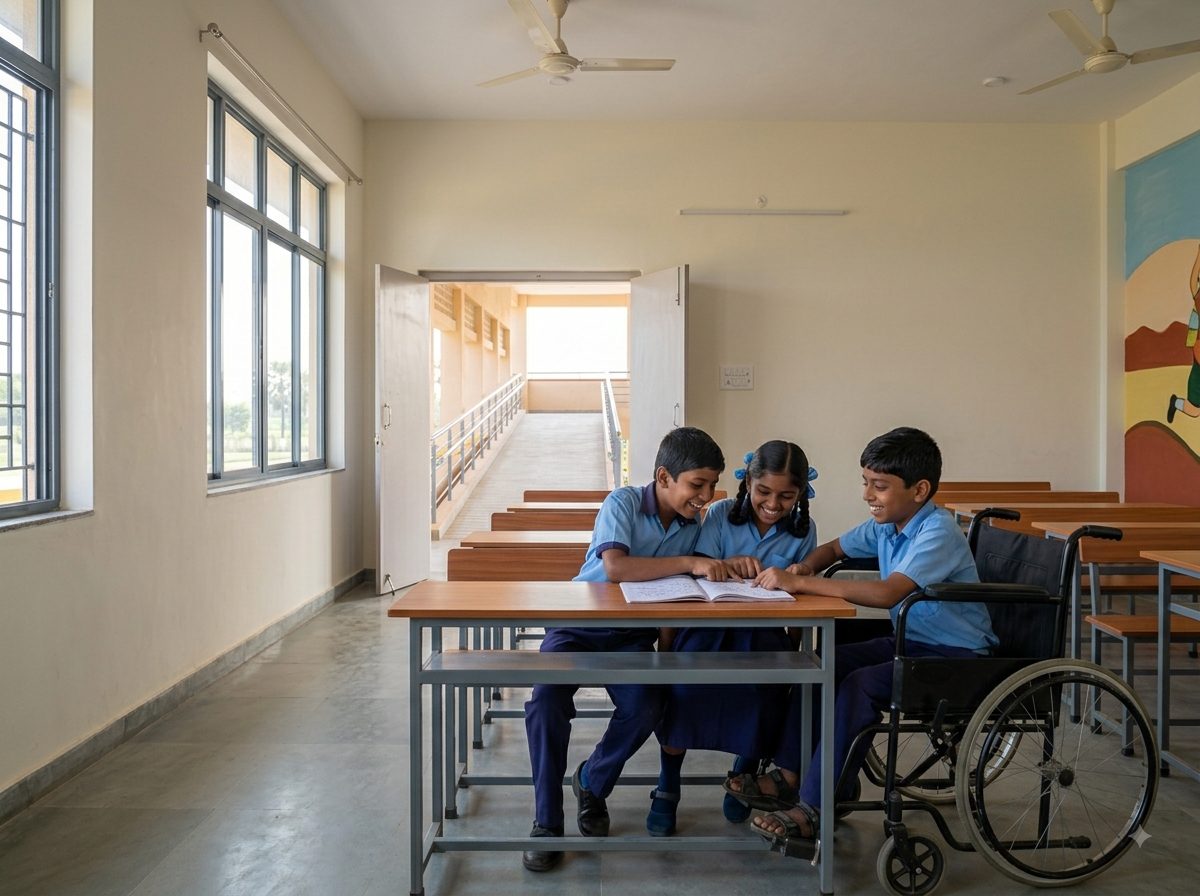
❤️Care, Health & Inclusion
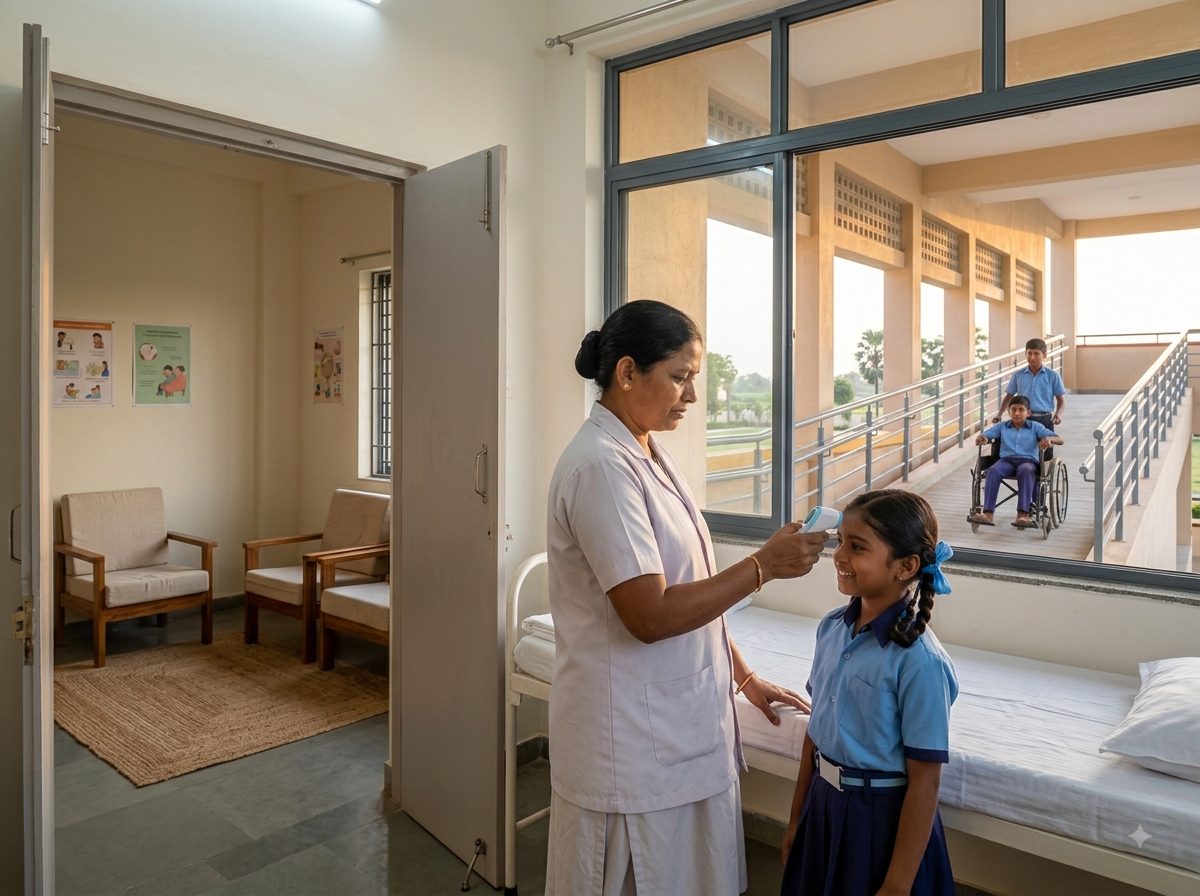
A campus that bends to fit every child — not the other way round.
28Safe drinking water with RO or appropriate technology
31Clean toilets for girls and boys with running water — every toilet block including one WC room for children with special needs
36A barrier-free campus, so children with special needs can reach classrooms, toilets, play areas and dining halls
37A health room, including a girls’ sick area
38A special learning room for children with special needs
39A counselling room for students, with a specially appointed counsellor
✓ 6 of the 45 standards — included as standard, not a premium add-on. Numbers are the report’s own.
Zone 7 of 8
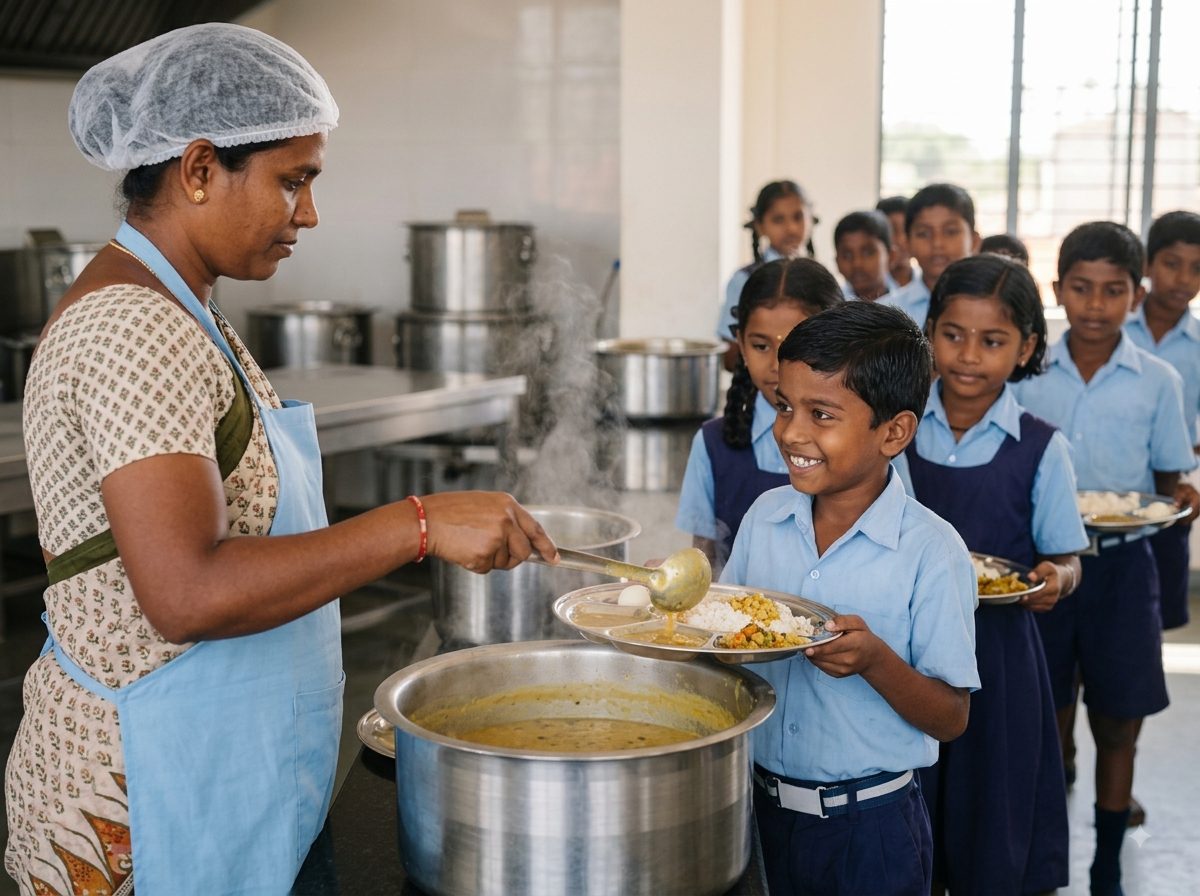
🍲Nutrition & Dining
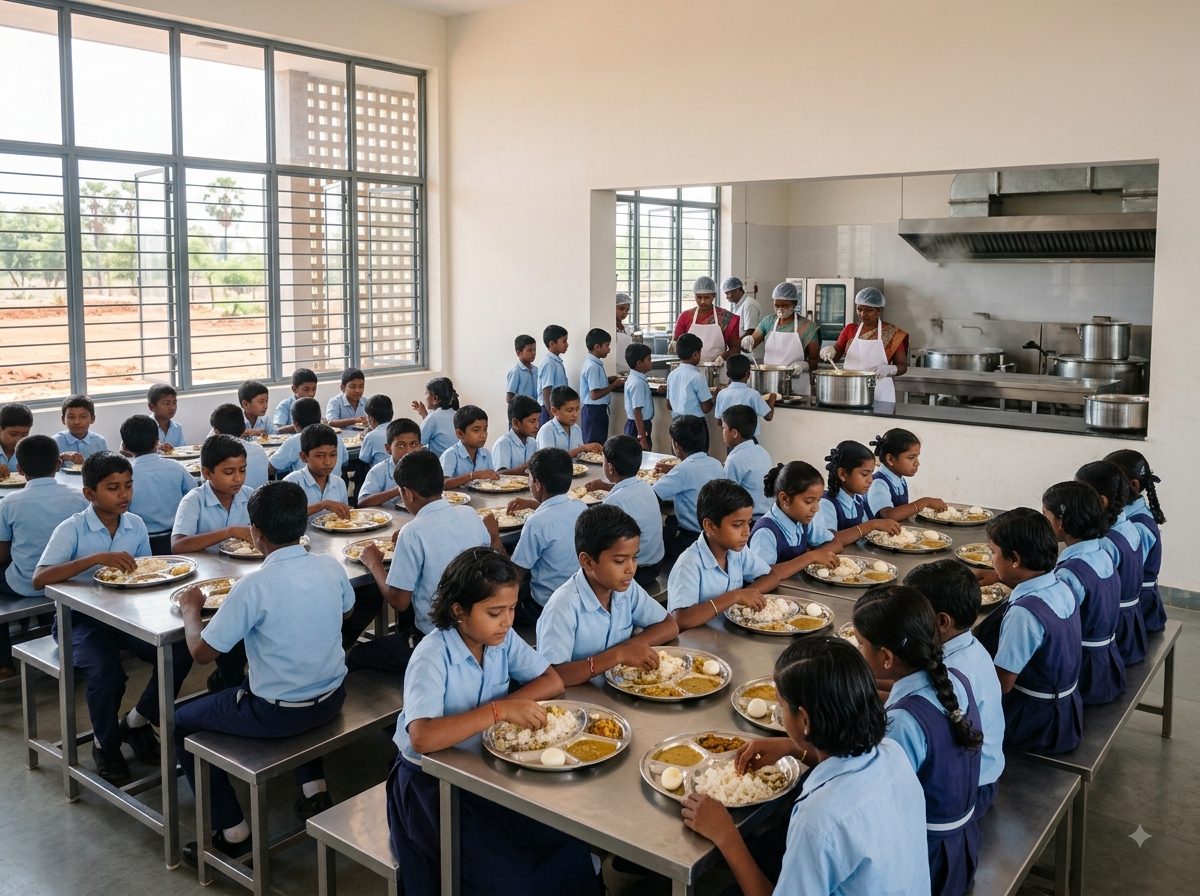
A kitchen built to cook properly for 1,500 children, three times a day.
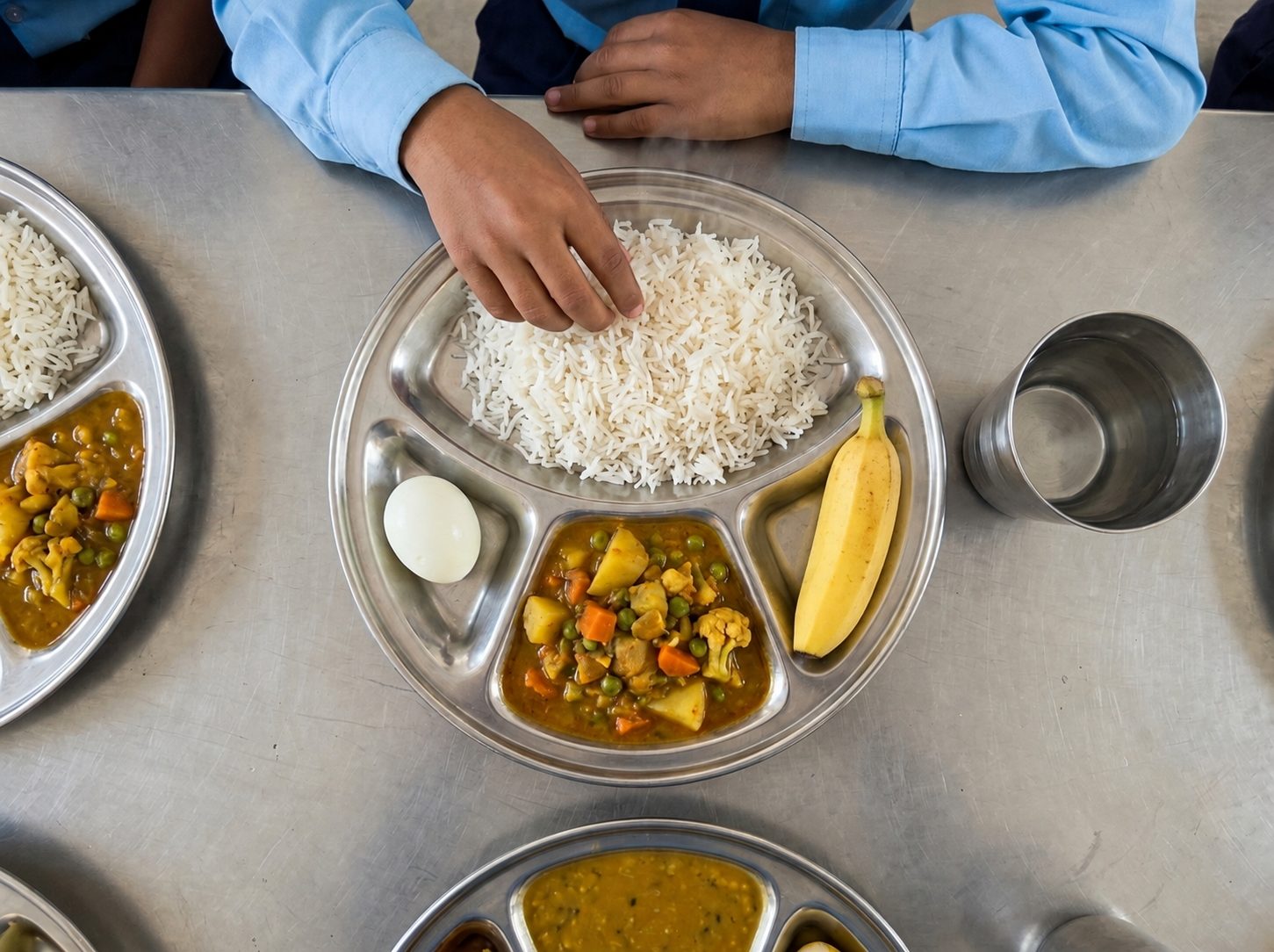
6A modern kitchen and storeroom with steam-based cooking and stainless-steel vessels
7A dining hall with stainless-steel seating and movable benches, designed to double as a multipurpose hall for meetings and indoor games
✓ 2 of the 45 standards — included as standard, not a premium add-on. Numbers are the report’s own.
Zone 8 of 8
🛡️Safety & Campus
Land, walls, cameras and footpaths — and proper rooms for the people who run the school.
1A minimum of 4–6 acres of land, at a selected existing ZPHS or Model School
8Separate staff rooms with attached toilets for male and female staff — one each for primary, secondary and higher-secondary levels
9One room for the Headmaster with an attached toilet, separately for primary, secondary and intermediate levels
10One chamber for the Head of School, with an attached toilet
11One room for the examination branch
15One large office room, to accommodate up to six supporting staff
16One store room each for primary, secondary and high school
27Strong compound walls with sturdy tall gates — minimum 8 ft high, with 1.5 ft of wired fencing on top
29CC cameras in all classrooms and at other strategic locations on the campus
41Concrete footpaths connecting the different buildings
45One watchman’s quarter
✓ 11 of the 45 standards — included as standard, not a premium add-on. Numbers are the report’s own.
A day in this school
The timetable is already written.
Not a vague promise about “holistic development.” The report sets out the actual day — down to what is served on a Tuesday.
🔔9:00
Assembly, then breakfast
Over the public-address system, inside every classroom. Food before lessons.
⚽Every day
A games period. Every single day.
Four houses — Blue, Yellow, Green, Purple — from Class 1 to 12.
📖Twice a week
Library, on the timetable
Two periods a week. Every grade, 1 to 12.
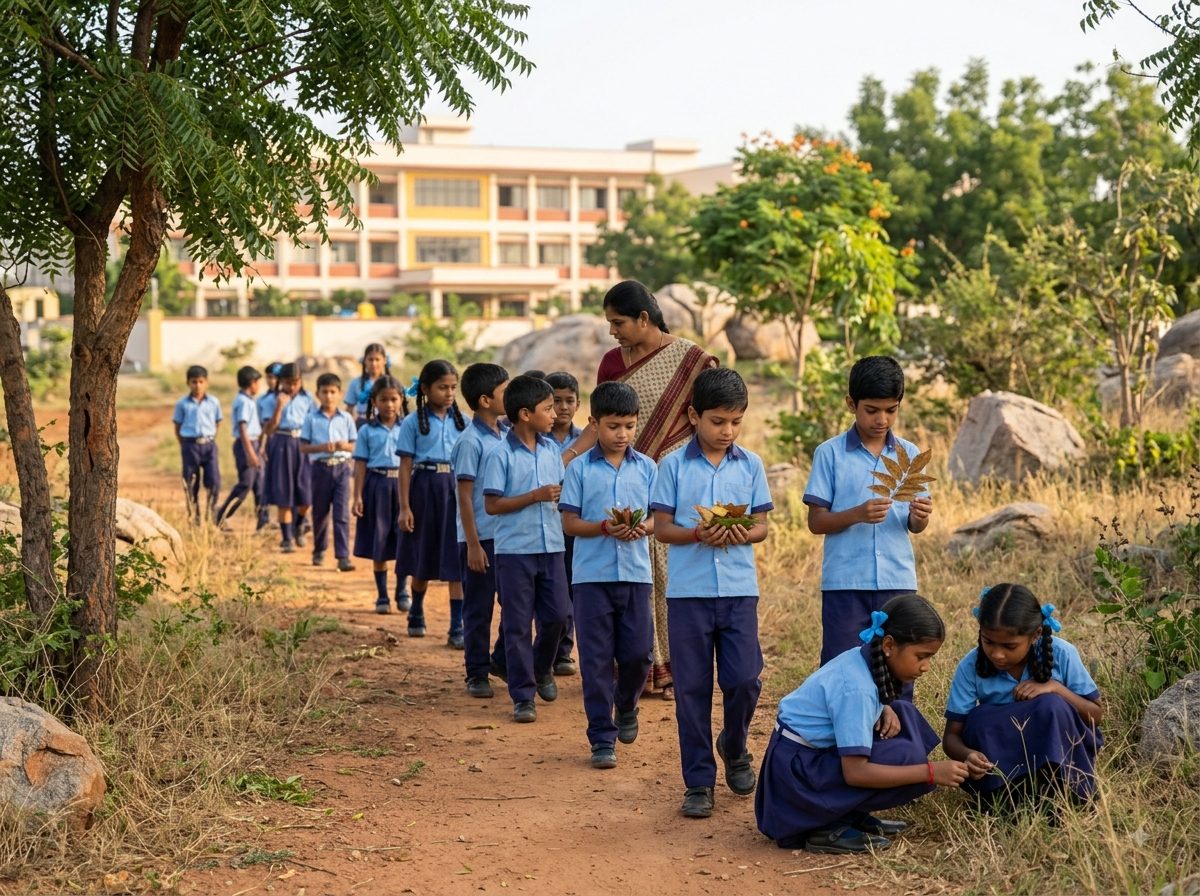
🌿Weekly
A walk outside
UKG to Class 5. Insects, leaves, what grows where.
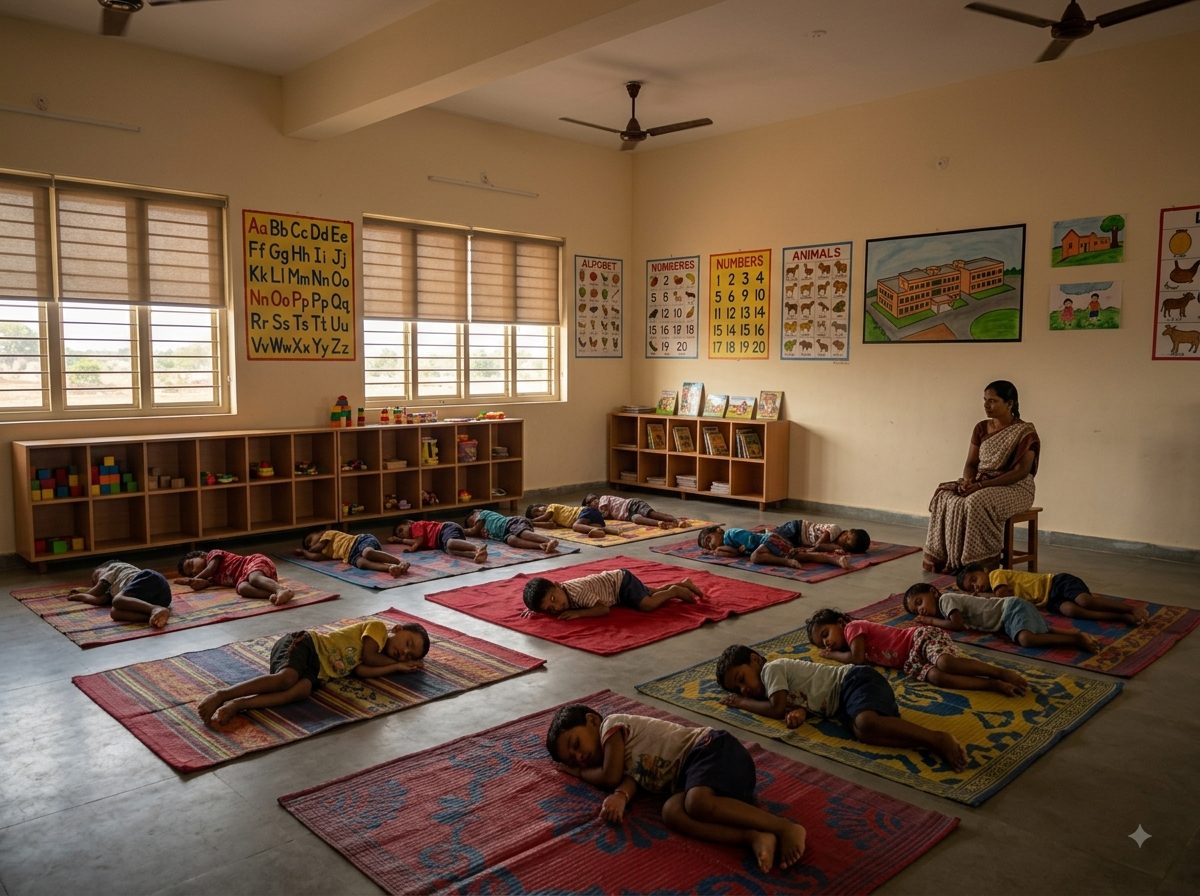
😴After lunch
The little ones sleep
Pre-primary carry no textbooks at all. A water bottle and a snack.
🕒4:00
School ends
Or stay till 5:15 — a club, a sport, extra help.
🎓4:30–6:30
Coaching. On campus. No fee.
For Classes 9 and 10 — the thing families take loans to pay for.
🏃Till 8:30
The athletes stay later
With a physical-education teacher alongside them.
Nature walk
Nap time
Evening coaching
Artist's impression
Straight from the reportThis week’s food
Artist's impression
3 meals a day
4 eggs a week
Milk or ragi malt every morning
The proposed weekly menu for breakfast, lunch and evening snacks at a Telangana Public School
Day
Breakfast
Lunch
Evening snack
Mon
Idly with chutney + milk
Rice, beerakaya curry, pappu chaaru + egg
Corn flakes mixture
Tue
Vegetable pongal or poha + ragi malt
Rice, beans curry, leafy dal + egg
Flattened rice mixture
Wed
Upma + milk
Rice, vankaya curry, pappu chaaru + banana
Boiled peanuts or chana
Thu
Khichdi or tomato bath + ragi malt
Bagara rice, tomato-aloo curry + egg
Seasonal fruit
Fri
Lemon rice or semiya upma + milk
Rice, bendakaya curry, pappu chaaru + egg
Samosa
Sat
Poori with aloo curry, or vegetable khichdi + ragi malt
Vegetable pulao, tomato chaaru + banana
Boiled chickpeas or corn
Every school day, for every child. The cooks are hired from the village by the parents’ committee — who also inspect the kitchen.
Inside the classroom
Play, not rote. And one promise you can hold them to.
“By the end of Class 5, every student shall acquire reading, writing and speaking in their mother tongue and English, and achieve numeracy proficiency.”
Pre-primary is play — circle time, stories, songs, movement. Nothing written, nothing tested.
2×
English, every single day
Plus a 45-seat English lab with headphones and a shelf of graded readers.
6–12
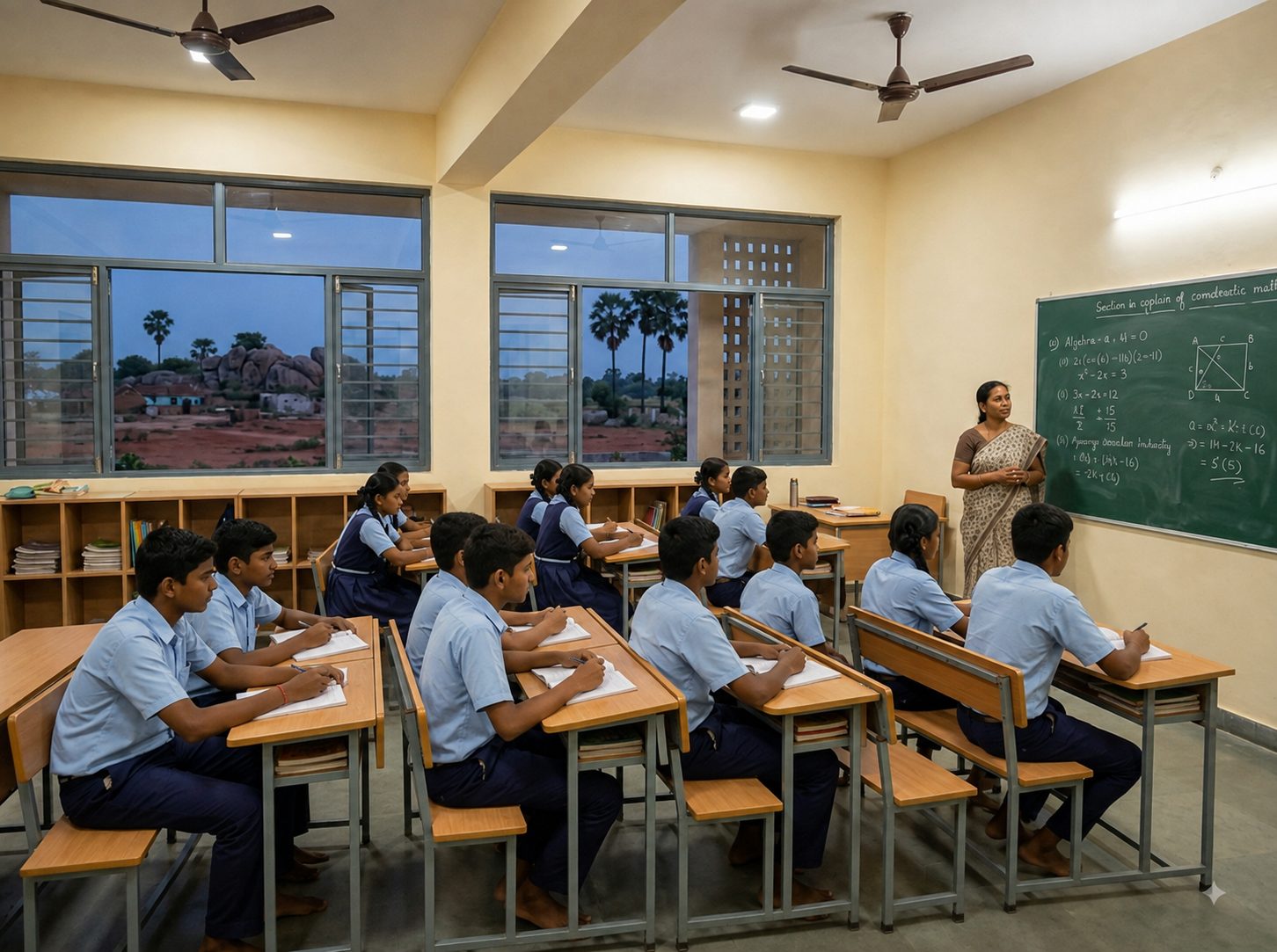
Every maths class, in a maths lab
Geometry kits, abacuses, tangrams — and a screen to show what a graph is doing.
90
Computers, from Class 3
Two laboratories of 45 machines. They double as AI labs.
🎯
Grouped by level, not age
Regrouped as they catch up. In the early grades, tested by talking — not by writing.
🤝
Children teach each other
Classes 6 to 8. And from Class 6, every project is your own.
Maths lab
English lab
Artist's impression
Same SCERT curriculum as every other government school. What changes is how it is taught.
Who works here
A school is not just a building. This one is staffed by 29 kinds of people.
One campus of 1,500 children can afford specialists that a village school of 20 never could.
Artist's impression
1Head of School
3Head MastersNursery–3, 3–8, 9–12
+20%TeachersOne for every section — and then a fifth as many again
4Pre-school teachers
1:100Literacy & numeracy tutorsClasses 1–5
9·10Special tutorsClasses 9, 10 and intermediate
6Physical-education teachers
3Music, art and danceOne teacher each
2Librarians
2Laboratory assistants
2Computer instructors
1Nurse, on campus
1:2CounsellorShared with the next campus
1Estate ManagerEverything that isn’t teaching
1:150Sanitation staffHalf of them women
2:300Security guards
1Head cookWith cooks and kitchen helpers
1Transport supervisor
40 hours of training a year — for the teachers
In person, for every one of them. And the gaps are found by an outside agency watching real classrooms, not by the school marking itself. The Head Masters never stop teaching either: 12 periods a week, each.
A school that sets its own paper, invigilates its own hall and marks its own answer sheets can produce any result it likes. So this one does none of the three.
01
Someone else sets the paper
An independent authority — the Telangana Education Standards Authority — prepares one standard question paper for the whole state, for every grade from Class 2 to 12, and its own officials conduct the examination.
02
Answer sheets lose their name
Evaluation happens entirely online. Papers are scanned and uploaded, stripped of school and student names, and then randomly assigned to teachers across the state.
03
Board students swap schools
Classes 10, 11 and 12 sit their examinations in a different school from their own. Two CC cameras in every room, so that every corner is covered.
04
The school still tests — it just doesn’t grade
Teachers run their own assessments through the year, half competency-based and half syllabus-based. What they cannot do is mark the exam that counts.
None of it asks you to trust the school. That is the whole point.
Who marks the school
For once, it’s the school that gets a report card.
Children have always been the ones ranked. Here, every six months, so is the school — and unlike yours, its report card is published.
School report cardIssued every six months · published, not filed away
Student attendance
Learning outcomesContinuous assessment, learning levels, national survey scores
EquityWhether girls, Dalit, Adivasi and disabled children are learning as well as everyone else
Feedback from parents and inspectorsWhat families say at meetings, and what officials see on a visit
Sport and competitionsExtra credit when children win
+
Scored, then ranked against every other school — in its mandal, its district and the state. The Chief Minister reviews the rankings.
📡
Watched live, not once a year
Every campus is wired into the state’s Vidya Samiksha Kendra: enrolment, student and staff attendance, assessment results, classroom observations, whether the meal was actually served, the state of the buildings, and where the money went.
📋
And officials have to turn up
The Director of School Education must visit at least four schools a month; the Education Secretary at least two. Which schools is decided randomly by an app — not by the officer, and not by the school.
🗣️
The parents review it monthly
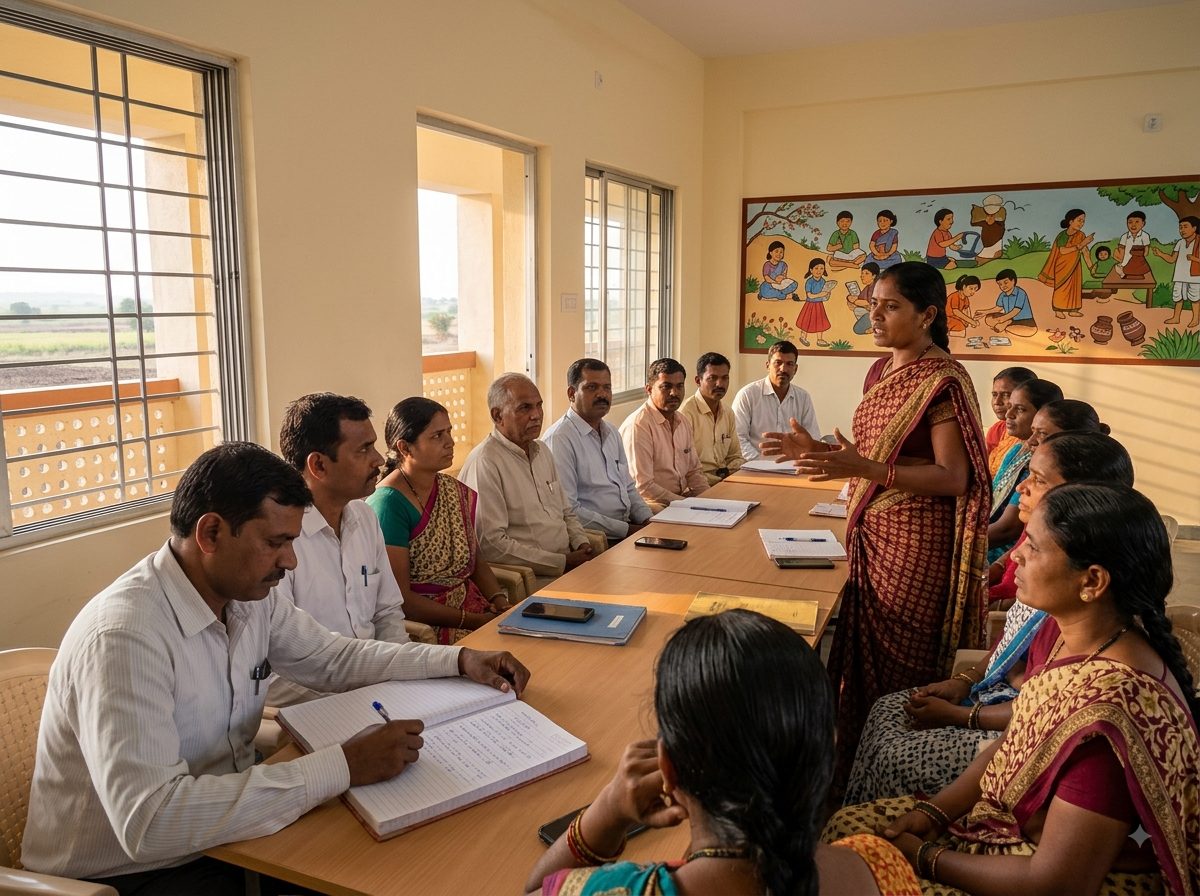
The parents’ committee meets every month to go through exactly this: attendance, results, remedial progress, repairs — and how the school’s money was spent.
Equity isn’t a paragraph in the introduction. It is one of the numbers the school is scored on.
The scale of the promise
This isn’t a pilot dream. It’s a costed, phased plan.
2,190
schools across Telangana, fully scaled
632
mandals covered
~33 lakh
students set to benefit
~65 lakh
parents relieved of the burden
₹15 cr
to build one campus — the whole thing, all 45 standardsthe feasibility anchor
₹0
school fees — completely free
45
facilities as standard
5
school buses per campus
1,500
students per campus
₹10,000 cr
saved for families every yearthe report’s estimate, if 20 lakh children come back from private schools
Two phases from 2026. Source: Education Policy for Telangana 2026, Telangana Education Commission — §4.5 and Table 4.1. What the programme costs the state is in the next section.
The obvious question
But how can the government afford this?
Fair question. The whole plan is only two bills — one you pay once, one you pay every year. That is the entire cost.
Paid once
₹34,274 cr
Building all 2,190 campuses, and putting five buses on the road at each one. Spread across six years — then nil, for good.
Then every year
₹5,694 cr
Salaries for the specialists a village school never had, and three meals a day for every child. The only number that doesn’t go away.
2,190 campuses by 2032‑33
Spread over 6 years — not paid at once
₹15 cr per campus
The yearly bill starts at zero — there is nothing to run until the first campuses open — and only reaches ₹5,694 crore once all 2,190 are running. After that the building stops for good and the yearly bill is all that is left. Source: Education Policy for Telangana 2026, Table 4.1 — capital ₹32,850 cr + buses ₹1,423 cr paid once; staff ₹3,285 cr + meals ₹2,409 cr a year at full scale.
What the state budget carries, year by year
2026‑27₹6,000 cr
2027‑28₹7,300 cr
2028‑29₹9,240 cr
2029‑30₹8,525 cr
2030‑31₹8,849 cr
2031‑32₹9,609 cr
2032‑33₹5,889 cr
2033‑34onward₹5,694 cr
Building it — once
Running it — every year
The heaviest year is ₹9,609 crore, and it happens once. After that the building stops, the line goes flat, and the state is left carrying ₹5,694 crore a year — for 2,190 schools serving 33 lakh children.
And now the answer
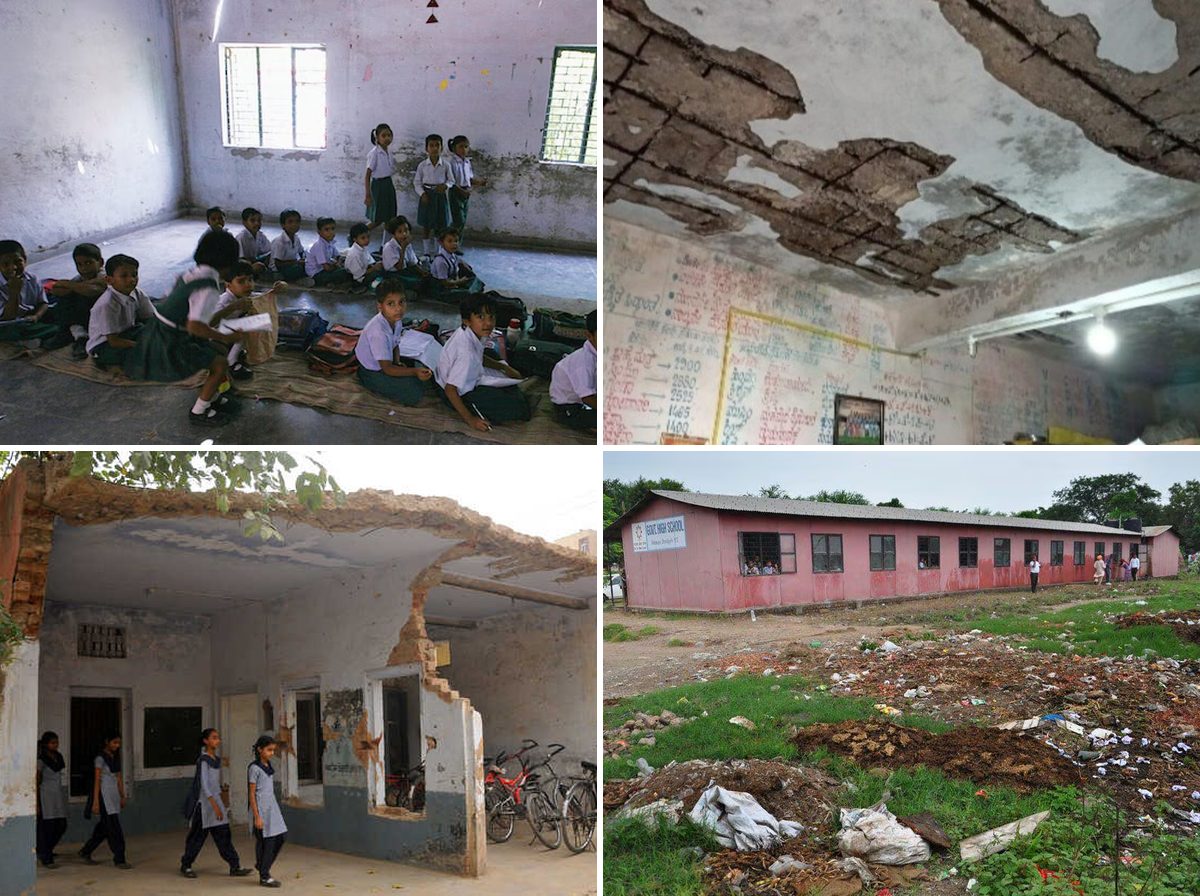
The money isn’t missing. It’s spread across 24,222 crumbling buildings.
Telangana already runs 24,222 local-body schools for 16.8 lakh children, with 1.1 lakh teachers on the payroll. The problem was never the total. It is how thinly the total is divided.
And most of what a new school would normally cost, this one never has to buy.
1 : 15Teachers per child — already1.1 lakh teachers for 16.8 lakh children. The state’s private schools manage 1 to 23.
1,920Schools with no children in themAnd 9,737 more with thirty or fewer. Already built, already staffed, already funded.
0New teachers to recruitThe teachers move to the campus with the children. The recurring budget buys specialists, not headcount.
0Acres of land to buyEvery campus is an upgrade of an existing ZPHS or Model School. The land is already the state’s.
₹0To a contractorThe parents’ committee awards and executes the work itself, and keeps the books.
50%Of a bus — not a fleetLocal entrepreneurs buy and run them on a 50% subsidy and a 40% loan. The state owns none of them.
It costs less to run than it saves
₹5,694 crore a year keeps all 2,190 campuses staffed and every child fed three times a day. The report puts the saving to families at ₹10,000 crore a year, once 20 lakh children no longer need a private school. The state would spend a little over half of what its own citizens stop paying — and it would own 2,190 schools built to last a century.
A hot breakfast, lunch, and evening snack — every day, free.
A nurse on campus, and a counsellor on a regular schedule — because children’s bodies and minds both matter.
Once a year every child is checked properly:
eyes, ears, teeth, anaemia
screened for autism, ADHD and learning difficulties — so that nothing is mistaken for laziness
Built for every child:
fully wheelchair-accessible
a special-needs learning room and accessible toilets
modified games, so nobody sits out sports day — at school, district or state level
Music, art, and dance teachers — not “extras,” but part of growing up whole.
For girls:
haemoglobin testing twice a year
menstrual health support and supplies
a quiet partitioned room with four beds, for the days when you just need to lie down
A Constitution Park with the Preamble engraved — so children grow up knowing they belong to this republic.
We, the people of India, having solemnly resolved to constitute India into a sovereign socialist secular democratic republic…
JusticeLibertyEqualityFraternity
Photographs of the campus are artist's impressions
And the smallest children don’t travel far at all: each campus is fed by three or four Telangana Foundational Schools — Nursery to Class 2, built to the same standard, in the neighbourhoods themselves.
No entrance exam. No fees. Admission by lottery or first-come. Every child, welcome.
Whose school is it?
The parents run it.
Not a department in a far-away city. The people whose children walk through the gate every morning are the ones who govern the campus, and even own the buses.
🗳️A committee of parents governs it
Every parent in the school is called to a meeting, and the School Development & Management Committee is chosen there.
The head of the school sits on it as convener — not as its boss.
Reconstituted every two years, with a third of the members held back by draw of lots — so nothing is forgotten and nobody settles in.
🧱They build it themselves — without contractors
While the campus is being built
The committee meets every week and keeps signed minutes.
It votes on every decision — which vendor, which rate, which material.
It keeps a full set of books, down to a daily log of labour and materials.
There is no contractor standing between the village and the school.
Whatever parents raised at the last parent–teacher meeting.
🚌The buses belong to the village
The five buses at each campus are bought and run by local entrepreneurs.
Ideally parents of the students themselves — and preferably from a Scheduled Caste, Scheduled Tribe or Backward Class family.
The bus is registered in the committee’s own name.
A parent doesn’t just use the transport; a parent can own it.
How a family buys a school bus
50%40%10%
Government subsidy
Bank loan
Own investment
🛟And somebody is watching that bus
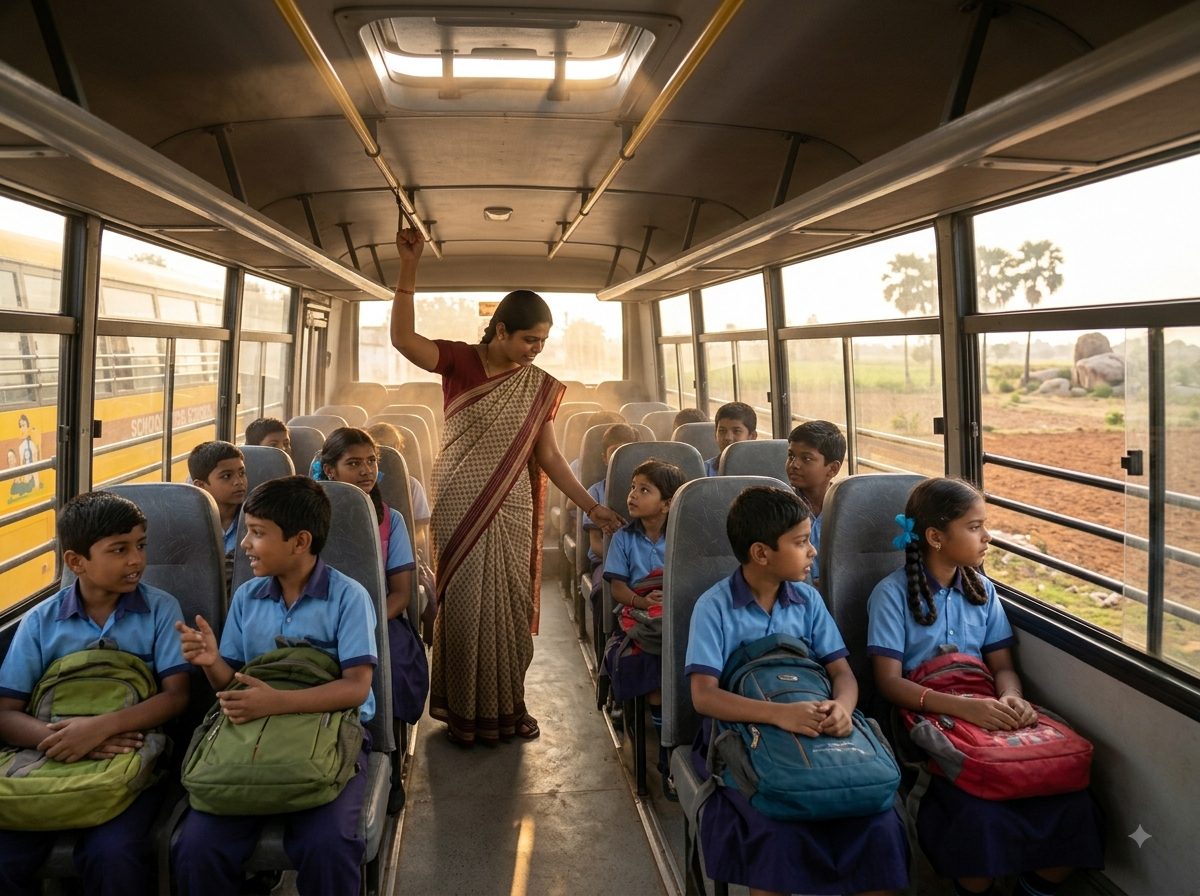
On board: GPS tracking, a camera, a fire extinguisher and a first-aid kit.
Drivers: commercial licences, police-verified, trained in child safety.
Never more than 70 children in one trip, and a register of who boarded, every single day.
And every route carries a childcare assistant — chosen from the last village on that route, so she is aboard from the first stop to the last — to lift the small ones up the step and hand them down again.
⚖️And nobody is forced into it
No village school is closed down to make this work. Parents keep three choices:
the small school nearby
a private school
or this one
It simply happens that the free one is now the best one: better resourced than the private school, with safe transport to the door.
He is not a commentator on government schools. He has rebuilt them at scale before — which is why this plan is costed like something meant to be built, not argued about.
15,715
government schools rebuilt
As school-infrastructure adviser to Andhra Pradesh he ran Mana Badi: Nadu-Nedu, which rebuilt 15,715 existing small schools in its first phase — classrooms, drinking water, and toilets that girls could actually use.
40 yrs
in public service, here and abroad
Joined the state engineering service in 1981 and rose to the IAS. From 1994 to 2000 he was National Project Manager of the United Nations Development Programme’s South Asia Poverty Alleviation Programme — the SAARC initiative in Mahabubnagar that first organised self-help groups into village and block federations. Later Director of MGNREGS in undivided Andhra Pradesh, Director General of the State Archives, and District Collector of Jayashankar Bhupalpally from 2016 to 2018.
SERP
chief executive
Ran Telangana’s Society for Elimination of Rural Poverty, the World Bank‑supported body that organises rural women into self‑help groups — among the largest programmes of its kind anywhere.
This plan
his last official act
Appointed Chairman of the Telangana Education Commission in September 2024. He handed the government Education Policy for Telangana 2026 — the report on this page — and stepped down in May 2026, four months early, saying the Commission’s work was done.
IMG22 placed
You can help send every child in India to a school like this. Free.
The plan exists. The cost is known. What’s missing is demand. Make some noise.
One decision away
Akunuri Murali built this plan as chairman of the Telangana Education Commission, and stepped down when the government did not act on it. Some say the private school lobby will not allow it, but we don’t know. Telangana is governed by the Congress — so the plan begins the day Rahul Gandhi says “start”.
Ask Rahul Gandhi to start it in Telangana
Congress governs Telangana. One instruction from him and the first campuses begin — and he may not know this plan exists.
Ask Cockroach Janta Party to take up this cause nationally
They have just started campaigning on government schools called #SchoolThikKaro. This is the thing that campaign is missing: a finished, costed plan, ready to be demanded.